Fat freezing and fat-dissolving injections: what actually happens to a fat cell
Neither of these is weight loss. Both destroy fat cells in one place and leave energy balance where it was. The unflattering part is a number: the manufacturer’s rate for cryolipolysis’s best-known complication and the rates independent groups publish disagree, and that complication has never been documented resolving on its own.
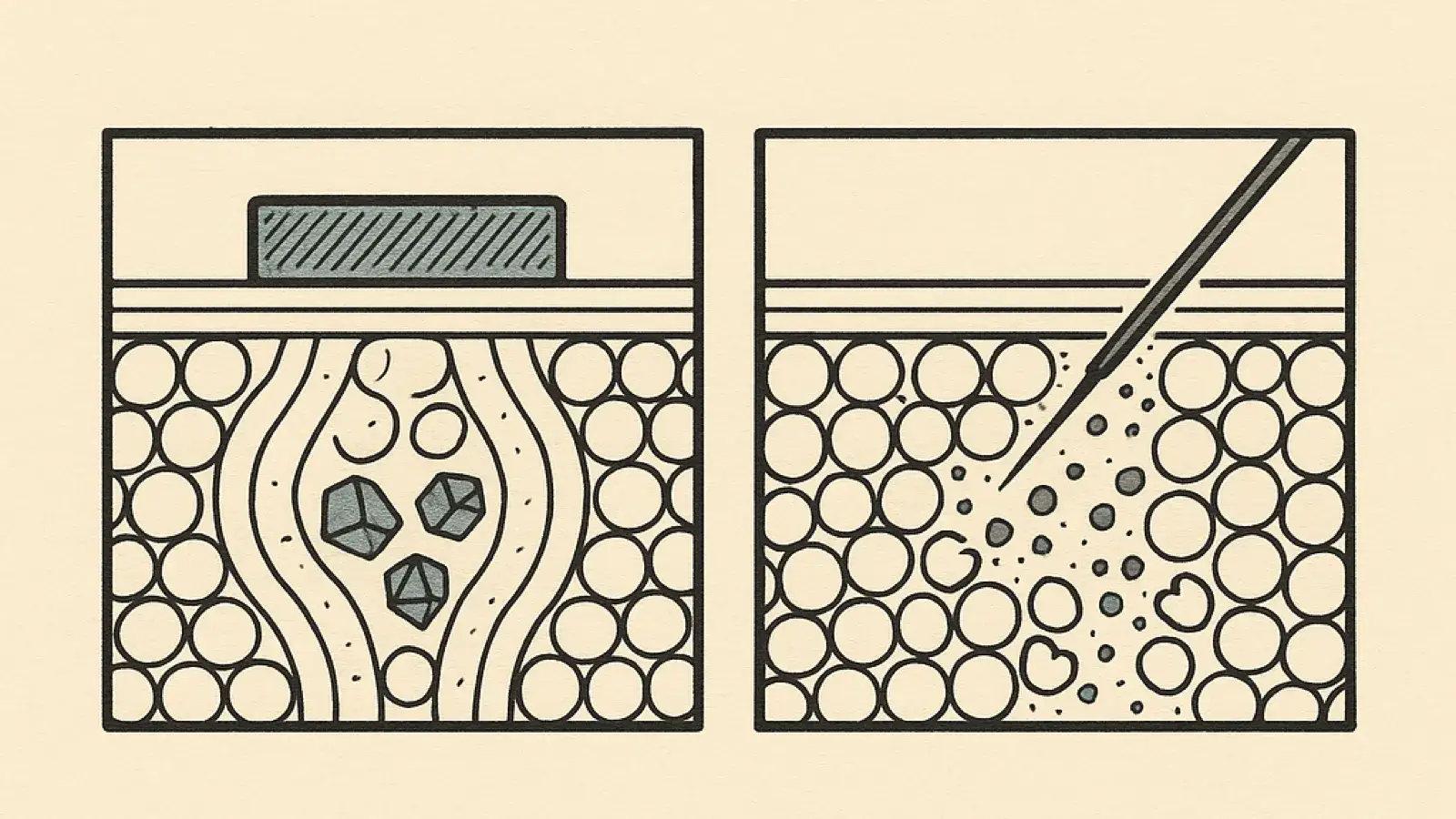
What it actually is
Two treatments, one goal, almost nothing else in common. Both depend on an accident of physics that leaves fat more vulnerable than its neighbours.
N Engl J Med
1970
282(17):966–7
Cold, and why fat freezes first
The founding observation came from paediatrics. In 1970 the New England Journal of Medicine published a two-page report titled “Popsicle panniculitis”, describing firm red nodules in the cheeks of infants who had been sucking on frozen ice lollies: benign inflammation of the fat, which settled without treatment. The account this field works from is that lipid crystallises at a higher temperature than water, so lipid-rich tissue can be damaged at temperatures that spare water-rich tissue. It is the proposed mechanism, not a directly demonstrated one.
Lasers Surg Med
2008
40(9):595–604
A 2008 paper in Lasers in Surgery and Medicine tested that in pigs, cooling test sites to preset temperatures of 20, −1, −3, −5 and −7 °C for ten minutes. Cooling produced a lobular panniculitis, followed at some sites by “grossly obvious loss of several mm of subcutaneous fat occurring gradually during the 3.5 months study period” — a period observed in a single animal, the rest being followed to 28 days. The histology: fat cells lost, lipid-laden inflammatory cells arriving, fibrous septae thickened. On the skin the paper hedges, and the hedge is the word that matters: “Typically there was no clinical or histological evidence of injury to skin, and no scarring.”
That is why the result is slow. Nothing is removed during the appointment: cold injures the cell, the cell dies by apoptosis, and the immune system spends weeks to months clearing the remains while the subcutaneous layer thins.
Detergent, and why it cannot tell one cell from another
Injected deoxycholic acid works differently, and the label states it in one sentence: the product “is a cytolytic drug, which when injected into tissue physically destroys the cell membrane causing lysis”. No receptor, no signalling step. It is a bile acid — the molecule the body uses to emulsify dietary fat — and in tissue it takes membranes apart.
Dermatol Surg
2010
36(6):899–908
A detergent cannot read a label, so why does the effect look selective? A 2010 study in Dermatologic Surgery reported that in vitro deoxycholate lysed every cell type it was tested on, and that physiological concentrations of albumin, and protein-rich tissue generally, reduce its ability to do so; fat, the authors concluded, may be “unable to sufficiently neutralize the detergent activity” because it is deficient in those proteins. Selectivity, on that account, is relative and depends on what the fluid touches. The approved label constrains both where the drug goes and how much of it goes in: injections placed too superficially “may result in skin ulceration and necrosis”; the product should not be injected into or in close proximity to salivary glands, lymph nodes and muscles; and the label caps the volume in one treatment and the number of treatments.
World J Plast Surg
2025
10 studies, n=285
Both mechanisms force the same sentence. This is cell removal in one place; neither touches appetite, absorption, or the calories a body spends in a day. The 2025 meta-analysis of cryolipolysis in the World Journal of Plastic Surgery found reductions in fat-layer thickness and in the circumference of treated regions alongside no significant change in body weight, and the manufacturer of the best-known device says the same thing in its own safety document, that its systems “are not treatments for weight loss”.
That same meta-analysis also reported a significant fall in body mass index, a mean difference of 1.71, which is hard to square with no significant change in weight, since body mass index is calculated from weight. Where a paper’s own two numbers do not sit together, the reading to take is that its pooled estimates are unstable, not that the treatment does two contradictory things.
What it is approved for
From the label
Kybella (deoxycholic acid) injection. Approved by the US Food and Drug Administration on 29 April 2015; prescribing information revised October 2024.
Indication, verbatim: “improvement in the appearance of moderate to severe convexity or fullness associated with submental fat in adults”.
Limitation of use, verbatim: use “for the treatment of subcutaneous fat outside the submental region has not been established and is not recommended”.
Contraindication, verbatim: the drug “is contraindicated in the presence of infection at the injection sites”. That is the label’s only stated contraindication; the warnings section adds several groups it tells prescribers to be careful with, listed further down this page.
A course, not a treatment: the label permits up to six treatments at intervals of no less than a month, and 59% of trial subjects received all six.
That is a full approval, the strongest regulatory position anything here occupies. It is also narrower than the marketing: one drug, one region, adults only, and an explicit statement that everywhere else is unstudied.
Cryolipolysis is cleared, not approved
21 CFR 878.4340
76 FR 6553
7 Feb 2011
Cooling devices arrive by another route. In August 2010 FDA granted de novo classification to the first contact cooling device of this type (record DEN090002). The regulation that followed — 21 CFR 878.4340, “Contact cooling system for aesthetic use”, at 76 FR 6553 on 7 February 2011 — created a class II category with special controls, for a cooling pad and massager “intended for the disruption of adipocyte cells”.
Everything since has arrived as substantially equivalent to what was already on the market. FDA’s device database returns fourteen records under this product code, the de novo of 2010 and thirteen 510(k) clearances between May 2012 and September 2024. Substantial equivalence asks whether a device is like the last one, not whether either works — the difference between cleared and approved.
Two things in that database are worth a reader’s attention. All fourteen records belong to a single manufacturer, so “FDA-cleared” in this category describes one company’s system and its successors, not a bar every machine marketed as fat freezing has been measured against. And while the regulation never mentions weight, the cleared indications do: the September 2024 clearance covers the arm, bra fat, back fat, banana roll, thigh, abdomen and flank “in individuals with a Body Mass Index (BMI) of 30 or less”, and the submental and submandibular areas “in individuals with a BMI up to 46.2”. A body-composition limit is written into the indication itself.
What the evidence establishes
Prescribing information
rev. 10/2024
Trials 1 and 2
The deoxycholic acid label reports two identically designed randomised, double-blind, placebo-controlled trials: 514 subjects treated and 508 given placebo across the two, with 513 and 506 in the pooled safety analysis. Both co-primary endpoints required the clinician and the patient to agree, twelve weeks after the last treatment. At least a two-grade improvement on both scales: 13.4% against under 0.1% in trial one, 18.6% against 3.0% in trial two. At least one grade on both: 70.0% against 18.6%, and 66.5% against 22.2%. In the subgroup imaged by MRI (449 subjects), 43% reached at least a 10% reduction in submental fat volume, against 5%.
Those numbers describe a particular room of people: healthy adults aged 19 to 65 with a body mass index of 40 or below, all graded 2 or 3 on a five-point scale of submental fullness and none with excessive skin laxity; mean age 49, mean body mass index 29, 85% women and 87% recorded as Caucasian. Nothing in the trials speaks to anyone outside that description.
Randomised trials consistently separate the drug from placebo on every one of those measures. But the one-grade change happened for about two thirds of treated subjects, the two-grade change for roughly one in six.
Plast Reconstr Surg
2015
135(6):1581–90
Cryolipolysis has no approval dossier, so its evidence is whatever investigators published. A 2015 systematic review in Plastic and Reconstructive Surgery gathered 19 studies reporting average reductions of 14.67% to 28.5% by calliper and 10.3% to 25.5% by ultrasound; one of its authors declares himself a consultant to the device manufacturer, which is disclosed in the paper and belongs beside the numbers. The 2025 meta-analysis pooled 10 studies in 285 participants and reported a mean difference in fat-layer thickness of −3.56 (95% confidence interval −4.63 to −2.48), follow-up two to six months.
That figure needs two warnings beside it. The paper never states its unit, and it pools ultrasound measurements with skinfold calliper measurements, so “3.56” is not a millimetre reading anyone can quote with confidence; heterogeneity was I² = 95%, meaning the studies were not measuring one consistent effect. The evidence is limited to a small number of studies, most of them uncontrolled, inside a much larger uncontrolled literature. The individual studies that review discusses report ultrasound reductions of roughly 2.0 to 3.3 mm of fat depth. That is the size of the thing being measured, and it is not the figure that gets advertised; the percentages are.
Where the evidence runs out
Everything above is tissue. A calliper and an ultrasound probe measure the thickness of a layer, not whether anyone notices, whether it lasts, or whether it does the person any good.
The horizons are short: two to six months in the pooled cryolipolysis studies, and up to six months after the last treatment in the deoxycholic acid trials. What ten years looks like has not been studied. It is not clear whether a reduction in one area survives later weight gain. Destroying some cells in one place does not stop the cells that remain from enlarging.
The complication evidence has a structural hole. A separate 2025 systematic review, in Aesthetic Surgery Journal Open Forum, found that only 4 of its 28 included studies followed patients for at least 16 weeks, while the complication it was counting typically appears two to four months after treatment. A literature that stops looking before the event happens will report it as rare, and will do so honestly.
What it costs, and how it is priced
The pricing units differ, and neither is a price for a result. Cryolipolysis is sold by the applicator cycle: one applicator, one area, one cycle. The multicentre review below counted 8,658 cycles across 2,114 patients, a mean of 4.09 per person, which describes a course better than a single-cycle figure. Deoxycholic acid is sold by vial or session, across up to six sessions.
The most-cited national figure is undated. The American Society of Plastic Surgeons publishes an average fee for nonsurgical fat reduction of $1,157, attributed on its page to “the latest statistics” without a year, and states it “is only part of the total price – it does not include other related expenses”.
A quote for a first cycle leaves out the later cycles and the cost of correcting a complication. Correcting the enlargement described below is surgery, and StatPearls records that people affected by it “frequently face significant out-of-pocket expenses, as insurance typically does not cover these corrective cosmetic procedures”.
Risks and side effects
Who the labelling excludes
Both products carry written exclusions. The deoxycholic acid label states one contraindication: the drug “is contraindicated in the presence of infection at the injection sites”. Its warnings and its section on specific populations add three more groups. Subjects with a current or prior history of difficulty swallowing were excluded from the trials altogether, and the label tells prescribers to avoid the drug in those patients because it “may exacerbate the condition”. It tells them to use caution in patients on antiplatelet or anticoagulant therapy or with coagulation abnormalities, bruising having occurred in 72% of treated subjects. And it records “no adequate and well-controlled studies” of the drug in pregnant women.
For cryolipolysis the exclusions come from the device maker rather than a drug label, because a cleared device has no approved prescribing information. The manufacturer’s full safety information for the best-known system, a three-page consumer document, names three conditions under which a person “should not have treatment”: cryoglobulinemia, paroxysmal cold haemoglobinuria and cold agglutinin disease, all three being disorders in which cold provokes an abnormal reaction in the blood. It adds one more exclusion that is easy to miss: “You should not have the treatment if you are seeking treatment for obesity as CoolSculpting® is not a weight loss treatment.”
The same document lists a longer set of conditions under which a person “may not be an appropriate candidate”, none of it obvious from an advertisement: sensitivity to cold such as cold urticaria, Raynaud’s disease, pernio or chilblains; allergy to isopropyl alcohol, propylene glycol, fructose or glycerin, where use “may result in allergic reactions, including anaphylaxis”; impaired circulation, impaired skin sensation or nerve pain in the area; open or infected wounds; bleeding disorders or concurrent blood thinners; recent surgery, scar tissue or a hernia at or beside the site; eczema, dermatitis or rashes there; an active implanted device such as a pacemaker or defibrillator; chronic pain; and anxiety disorder. It adds that the procedure “has not been studied in children, those who are pregnant or lactating”, and that the system is “a prescription use only device”. Those exclusions travel with the machine, not with the premises it sits in.
Common
The deoxycholic acid figures are precise because the label prints them, treated against placebo: injection site reactions 96% against 81%; swelling 87% against 43%; bruising 72% against 70%; pain 70% against 32%; numbness 66% against 6%; hardening 23% against 3%; a nodule 13% against 3%. Still present after 30 days in more than one in ten subjects: numbness 42%, swelling 20%, pain 16%, hardening 13%. Numbness in two thirds of people, still there a month later in four in ten, is the ordinary experience of the treatment.
For cryolipolysis the 2015 review describes mild, short-lived redness, swelling and pain, and no significant change in blood lipids or liver function tests in any of the 19 studies. It also records paradoxical adipose hyperplasia in one patient, which is the complication set out below. The manufacturer’s safety document adds sensations during treatment — pulling, intense cold, stinging, cramping — and states that altered sensation, meaning itching, skin sensitivity, tingling and numbness, “can persist up to several weeks after treatment”.
Less common
In the same trials, difficulty swallowing occurred in 2% of treated subjects against less than 1% on placebo, resolving over 1 to 81 days, median 3. Weakness of the marginal mandibular nerve — a branch of the facial nerve that moves the lower lip, so the sign is an asymmetric smile — occurred in 4% against less than 1%. All such injuries in the trials resolved spontaneously, range 1 to 298 days, median 44. Two thirds of a year is inside that range.
Rare but serious
The label’s postmarketing section lists, without a denominator because voluntary reports have none: “injection site ulceration, necrosis, infection, alopecia, scarring, and mass”; hypersensitivity reactions “including rash, urticaria, and itching”; numbness or altered sensation in the mouth; and “vascular injury due to inadvertent intravascular injection”. Some infections “included cellulitis and abscess requiring intravenous antibiotic treatment and incision and drainage”. Of the hair loss, the label says the onset and duration “may vary among individuals and may persist”.
Aesthet Surg J
2024
44(10):1063–71
Cryolipolysis has one complication that is the mechanism’s own paradox. In paradoxical adipose hyperplasia the treated pad enlarges instead of shrinking: firm, painless, sharply confined to the shape of the applicator. A 2024 case series in the Aesthetic Surgery Journal — 33 patients, 60 treated sites, four surgeons, cases collected between June 2022 and June 2023 — reports a mean onset of three months, range nought to eight. StatPearls states that “there have been no documented cases of PAH resolving spontaneously without intervention” and that surgical management, by liposuction or direct excision, is the primary treatment; in the 2024 series 28% of patients needed two or three operations. The manufacturer’s own safety document concedes the same point in its own words, describing an enlargement appearing “two to five months after the treatment” which “is distinguished from temporary swelling and will not resolve on its own. Surgical intervention may be required.”
How often it happens depends on who counted.
| The figure | What it counts | Where it comes from |
|---|---|---|
| 0.0051% | 1 in 20,000, the figure reported when the condition was first described in 2014 | As reported in Aesthetic Surgery Journal Open Forum 2025;7:ojaf142 |
| 0.025% | Quoted by the 2021 multicentre review as the manufacturer’s rate at that time, “1 per 4000 cycles” | Aesthetic Surgery Journal 2021;41(8):932–941 |
| 0.033% | “About 1 out of 3,000 treatments” — the manufacturer’s own current figure, stated in the consumer safety document it gives patients | Full important safety information, CoolSculpting |
| 0.43% / 0.15% | 9 of 2,114 patients; 13 of 8,658 cycles | Multicentre review of 8 centres, Aesthetic Surgery Journal 2021;41(8):932–941 |
| 0.39% → 0.05% | Cycles on 2015–2016 equipment against cycles on 2017–2019 equipment, same review | Aesthetic Surgery Journal 2021;41(8):932–941 |
| 0.22% | Pooled across 28 studies and 13,078 patients (29 cases, 1 in 455), 95% confidence interval 0.10 to 0.47, graded low-certainty by its own authors | Systematic review and meta-analysis, ASJ Open Forum 2025;7:ojaf142 |
| 0.91%, up to 2% | About 1 in 110 treatments from a 2020 systematic review, and the top of the published range | As reported in StatPearls, NCBI Bookshelf |
Set the manufacturer’s current 0.033% against the 2% at the top of the published range and the estimates differ by a factor of sixty; take in the earlier figures and the spread is wider still. Three things can be said without picking a side. The direction is consistent: every independent count sits above the manufacturer’s, and the 2025 review states in terms that its pooled incidence “is 6.67× higher than that of the most recent manufacturer report”. That review does not attribute the gap to concealment; what it calls for is longer follow-up, “improved awareness and adverse event reporting” and fuller risk disclosure, which is a claim about how the condition is counted rather than about anyone’s honesty — and it is not a finding that the higher numbers are the true ones. And the unit matters commercially: a per-cycle rate looks smaller than a per-patient rate for the same events, and cycles are bought in multiples.
One finding cuts the other way: the 2021 multicentre review found the per-cycle rate fell by more than 75% when centres moved from older equipment to newer, 0.39% to 0.05%, with 76.9% of its cases occurring on the older models. That was measured independently of the manufacturer and it makes the generation of the machine a legitimate question. It is also a single review of eight centres, not a general finding. What causes the condition is unknown; StatPearls lists the proposals as enlargement of surviving fat cells, recruitment of precursor cells, loss of sympathetic nerve supply, changes in receptor signalling, low oxygen supply and the negative pressure of the applicator.
The enlargement is the best-known cryolipolysis complication but it is not the only one, and the manufacturer’s own safety document attaches a rate to each. Severe pain, about 1 in 6,000 treatments. Late-onset pain, about 1 in 6,000. Darkening or lightening of the skin, about 1 in 11,000, which it says typically resolves. Freeze burn, about 1 in 15,000, where “very rarely, second and third-degree burns may occur”. Excessive fat removal leaving a visible indentation in the contour, about 1 in 20,000. Vasovagal symptoms — dizziness, lightheadedness, nausea, flushing, sweating or fainting — about 1 in 30,000. Hardness or nodules in the treated area, about 1 in 30,000. Cold panniculitis, about 1 in 60,000, where a severe inflammatory response “may result in more extensive tissue damage, including fat tissue death, which may require medical or surgical intervention”. New or worsened hernia, about 1 in 185,000, which “may require surgical repair”. Two of those nine can end in an operation on the manufacturer’s own account, and the enlargement above is a third.
Treatment under the chin adds three of its own, and they rhyme with the drug’s. The same document states that cold reaching the hypoglossal nerve “may cause tongue deviation”, cold reaching the marginal mandibular nerve “may cause lower lip weakness”, and cold reaching the submandibular gland “may cause dry mouth, or decrease in saliva production”. Two very different treatments, aimed at the same small area, put the same nerve at risk.
Can it be undone
No. Cryolipolysis destroys fat cells and the cleared cells are gone; deoxycholic acid destroys cell membranes, which the label describes as lysis. Neither has an antidote or a reversal step, and on the published record paradoxical adipose hyperplasia cannot be waited out: no case of spontaneous resolution has been documented, and the correction on record is surgery, with its own risks and its own bill.
When to seek urgent care
The approved labelling and the published literature describe situations needing medical attention quickly rather than at the next appointment: skin at an injection or applicator site that breaks down, ulcerates or darkens; spreading redness, heat, swelling or pain, with or without fever, which the labelling links to cellulitis and abscess needing intravenous antibiotics and drainage; new difficulty swallowing or breathing; new facial weakness or an asymmetric smile; and, after cooling, blistering or a burn at the applicator site, or severe rather than moderate pain.
These describe what clinicians are told to watch for, not a method for assessing yourself. If any of it is happening, seek emergency medical care now. Products and devices can be reported afterwards, at where to report.
Questions the record supports asking
- Is the product an approved drug, a cleared device, or neither? Only one of those answers involves a finding that it works.
- For an injection: is it the approved deoxycholic acid product, and is the area to be treated the area its label covers? Anywhere below the chin is outside the approved indication.
- Which of the written exclusions has been checked? The drug label names infection at the injection site, a history of difficulty swallowing, blood-thinning medicine and pregnancy; the device information names three cold-related blood disorders, recent surgery and hernia.
- How many cycles or sessions does the plan involve in total, and what does the whole course cost rather than the first part of it?
- Which generation of applicator is on the machine? One independent multicentre review found the per-cycle rate of the enlargement complication fell by more than 75% between equipment generations.
- What rate of paradoxical adipose hyperplasia do you quote, and does it come from the manufacturer or the published literature?
- If the treated area enlarges instead, what happens next, who pays for the correction, and is the correction surgical?
- How long are patients followed after the last session? A complication first appearing at three months is invisible to a service that stops at six weeks.
- What is written down in advance about swelling, numbness and hardening beyond a month?
Alternatives, including doing nothing
Everything on this page changes a small volume of tissue in one place. Liposuction is the surgical comparator and is outside the scope of this article; weight change through diet, activity or medicine acts on the whole body, and treats a different thing.
Doing nothing is also on the list, and where the durability data stops at six months it is the option with the fewest unknowns attached. Nothing described on this page is without risk, and nothing described on this page treats body weight. Both sets of labelling place the decision about an individual with a licensed clinician who can take a medical history: the drug is prescription-only and its label states that injections should be administered only by a health care professional, and the device information asks patients to disclose their conditions and medicines before treatment.
The third category: injections with no US approval
Between the approved drug and the cleared device sits the largest group of products actually sold as “fat dissolving”, and it has neither status: injectable lipolytics with no US approval, usually mixtures of phosphatidylcholine and sodium deoxycholate. FDA’s consumer page names brands including Aqualyx, Lipodissolve, Lipo Lab and Kabelline, and states that these ingredients “pose a significant safety risk because they are unapproved, which means the FDA has not evaluated their safety or effectiveness”. The same regulatory gap runs through several other injectables sold on a proposed mechanism, which are taken up separately.
The mechanism claim is not the interesting problem here.
“FDA has received reports about consumers who experienced adverse reactions such as permanent scars, serious infections, skin deformities, cysts, and deep, painful knots after receiving unapproved fat-dissolving injections.”
US Food and Drug Administration, Using Fat-Dissolving Injections That Are Not FDA Approved Can Be Harmful, content current as of 20 December 2023.FDA warning letter
MARCS-CMS 699225
3 March 2025
On 3 March 2025 FDA wrote to a Philadelphia distributor, stating that its website “offers various injectable lipolytic products” and that those products “are unapproved new drugs introduced or delivered for introduction into interstate commerce in violation of sections 505(a) and 301(d) of the Federal Food, Drug, and Cosmetic Act”. Injectable products, it notes, “bypass some of the body’s key defenses against toxins and microorganisms”.
That letter was not an isolated one. FDA’s own roundup for that week records that it posted “six warning letters to companies responsible for introducing unapproved fat dissolving injectable drug products into interstate commerce” on the same day, and the first name on the list of recipients is Amazon.com. This is not a fringe supply route.
Swissmedic
26 March 2024
laboratory testing
Then the finding that makes the mechanism question moot. On 26 March 2024 the Swiss regulator Swissmedic warned about one of these products — the “Lemon Bottle” lipolysis solution, which also appears in the FDA warning letter above — after analysing samples from various sources in its own laboratory. Against declared ingredients of bromelain, lecithin and riboflavin, it found the contents “do not match the declaration and even vary greatly from one pack to another”: in one sample “the only substance found was caffeine”, while in another “none of the ingredients listed on the packaging could be detected”. Swissmedic states that no medicinal effect has been scientifically proven and regards the samples as falsifications.
This has not been evaluated in clinical studies, and for much of the category it could not be. You cannot evaluate the mechanism of a product when nobody in the room knows what is in the vial. That is the distance between the top of this article and the bottom: an approved drug with a modest measured effect and a printed list of its harms; a cleared device with a measured effect and a disputed complication rate; and a story about fat cells with, in tested samples, not even the ingredients on its own label.
Sources
- Kybella (deoxycholic acid) injection, prescribing information, revised October 2024, via DailyMed.
- US Food and Drug Administration, Using Fat-Dissolving Injections That Are Not FDA Approved Can Be Harmful, content current as of 20 December 2023.
- US Food and Drug Administration, warning letter, MARCS-CMS 699225, 3 March 2025; and FDA Roundup: March 11, 2025, for the six letters posted that day and the list of recipients.
- 21 CFR 878.4340, Contact cooling system for aesthetic use, 76 FR 6553, 7 February 2011; FDA device record DEN090002, decision date 24 August 2010.
- FDA 510(k) premarket notification database, product code OOK: fourteen records, the de novo of August 2010 and thirteen clearances from May 2012 to K233732, 12 September 2024, whose indications for use carry the BMI limits quoted above.
- Popsicle panniculitis. New England Journal of Medicine 1970;282(17):966–7.
- Selective cryolysis: a novel method of non-invasive fat removal. Lasers in Surgery and Medicine 2008;40(9):595–604.
- Tissue-selective effects of injected deoxycholate. Dermatologic Surgery 2010;36(6):899–908.
- Cryolipolysis for fat reduction and body contouring: safety and efficacy of current treatment paradigms. Plastic and Reconstructive Surgery 2015;135(6):1581–1590.
- Effectiveness of cryolipolysis in body contouring and fat reduction: a systematic review and meta-analysis. World Journal of Plastic Surgery 2025;14(3):16–26. The pooled mean differences are reported without units.
- A multicenter evaluation of paradoxical adipose hyperplasia following cryolipolysis: a review of 8,658 cycles in 2,114 patients. Aesthetic Surgery Journal 2021;41(8):932–941.
- Incidence of paradoxical adipose hyperplasia after cryolipolysis: a systematic review and meta-analysis. Aesthetic Surgery Journal Open Forum 2025;7:ojaf142.
- Paradoxical adipose hyperplasia following cryolipolysis. Aesthetic Surgery Journal 2024;44(10):1063–1071.
- Paradoxical adipose hyperplasia. StatPearls, NCBI Bookshelf; a tertiary reference, used for the range of published estimates and the management.
- Swissmedic, warning about an illegal lipolysis solution, 26 March 2024.
- CoolSculpting full important safety information for consumers (PDF), the manufacturer’s own three-page document, cited for the conditions that exclude a patient, the rare-event rates and the manufacturer’s current figure for paradoxical hyperplasia. A commercial source, used here because it is the labelling a patient is handed and because several of the admissions in it are against the seller’s interest.
- American Society of Plastic Surgeons, nonsurgical fat reduction cost; year not stated on the page.
Reviewed: 8 August 2026 · Evidence current to: 8 August 2026