Mesotherapy, PRP, exosomes and polynucleotides: the proposed mechanism, and what would have to be true
For every treatment on this page the substance being injected has no US approval for the purpose it is injected for, and in one case FDA’s own classification of the equipment records that its “safety and effectiveness … for in vivo indications for use has not been established”. One of the four carries a recent federal enforcement record. And the worst documented harm here had nothing to do with any mechanism: in April 2024 the Centers for Disease Control and Prevention published what it called the first investigation to associate HIV transmission with nonsterile cosmetic injection services, at an unlicensed spa selling platelet-rich plasma facials.
What these actually are
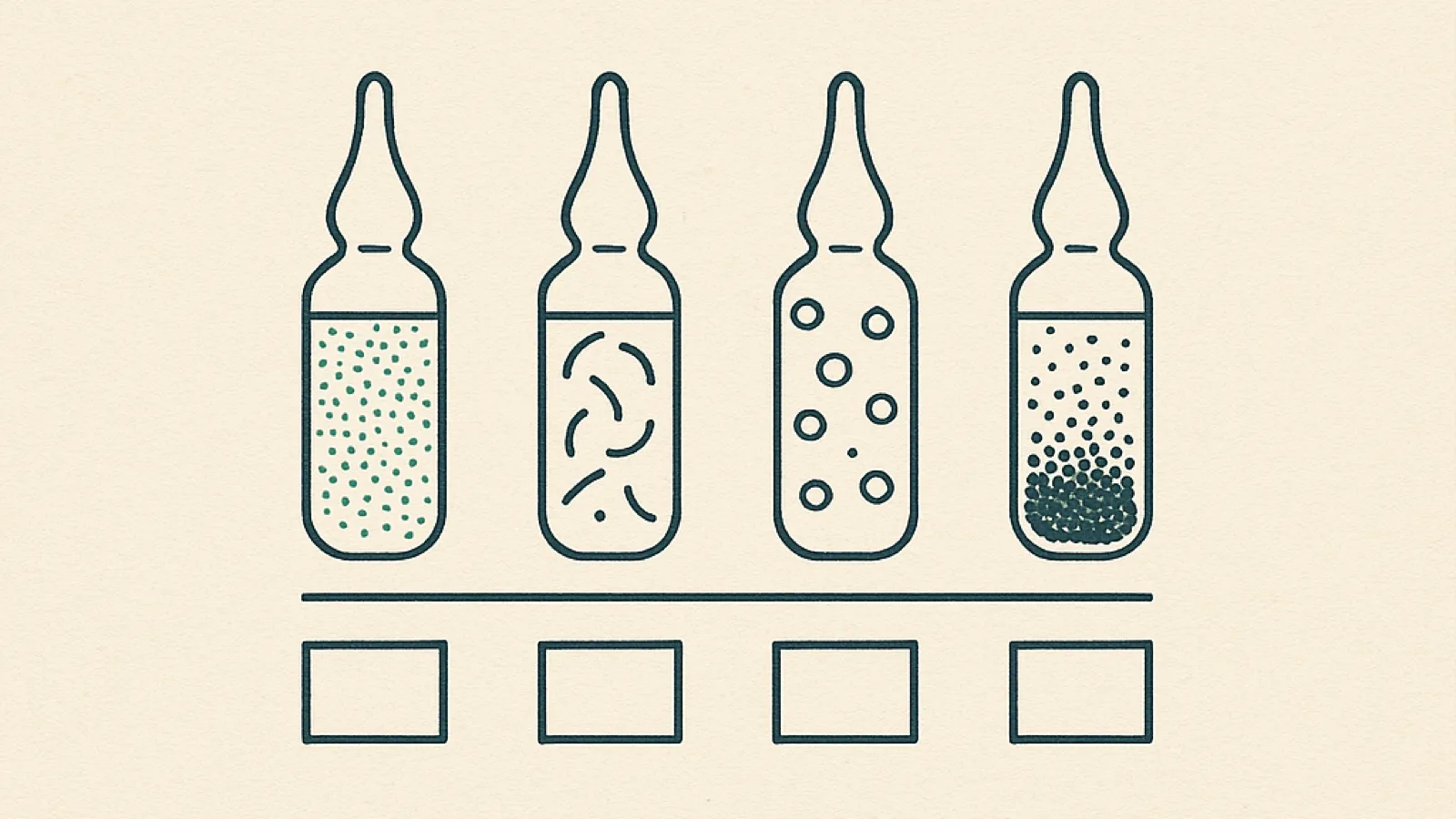
Facial mesotherapy is a mixture injected into the dermis across many small punctures. What is in the mixture is the whole question, because there is no standard one: vitamins, amino acids, minerals, coenzymes, non-crosslinked hyaluronic acid and pharmaceutical agents appear in different combinations. The claimed mechanism follows whatever is in the syringe, so the category resists being studied as one thing.
Platelet-rich plasma is the patient’s blood, spun in a centrifuge, with the platelet-rich fraction injected or driven into skin. Platelets carry granules of growth factors and releasing those in tissue is part of ordinary wound healing, so the biology is real. But a centrifuge protocol is not a product: what comes out depends on spin speed and time, how many spins, how the layers are drawn off, whether white cells are included and whether the platelets are activated.
Exosomes are small membrane-bound vesicles that cells release and other cells take up, carrying proteins, lipids and short RNA sequences. Signalling by that route is real, and the proposal follows: deliver the signal that stimulates repair without delivering the cell that would have sent it. Products come from cultured human cells, placental or amniotic tissue, or plants, and are not standardised between manufacturers.
Polynucleotides, also sold as PDRN, are purified DNA fragments, usually from salmon or trout sperm, proposed to act on adenosine A2A receptors on fibroblasts and to supply raw material to cells that are rebuilding. This family has the most trial data of the four — a statement about the other three as much as about this one.
What it is approved for
From the regulatory record
The approved comparator. FDA approved a hyaluronic acid microdroplet gel under premarket approval P110033/S059 on 11 May 2023, “indicated for intradermal injection to improve skin smoothness of the cheeks in adults over the age of 21”; a supplement approved on 11 June 2026 added injection “to reduce neck lines”. A named product, a named region, a named age floor.
Mesotherapy. No approval for the mixtures. The American Society of Plastic Surgeons records that most mesotherapy agents have not been approved for cosmetic use, and names one exception in the wider injection-lipolysis category: deoxycholic acid for submental fat, which is a single defined drug rather than a mixture. It adds a point that matters more than it sounds: mixing the ingredients “produce[s] a new drug that is not FDA approved for any purpose, [so] its use would not be considered ‘off-label’ use”.
Platelet-rich plasma. No approved product; what is regulated is the machine. The centrifuges sit in FDA product code QBV, 21 CFR 862.2050, a Class I category whose classification entry carries the note: “The safety and effectiveness of this device for in vivo indications for use has not been established.” A related code, ORG under 21 CFR 864.9245, covers separators cleared to prepare it “for mixing with bone graft”. FDA also states that microneedling devices “are not approved for delivery of … blood products (for example, platelet-rich plasma (PRP)) into the skin”.
Exosomes. FDA’s standing public safety notification is one sentence long on this: “There are currently no FDA-approved exosome products.”
Polynucleotides. No US approval for cosmetic injection. Products in this class are marketed as medical devices elsewhere: the trials described below were run in South Korea, and the systematic review described below carries declared relationships with an Italian manufacturer of polynucleotide medical devices and with that manufacturer’s distributor. Another jurisdiction’s route to market is not an FDA finding, and it is not a document a reader in the United States can hold FDA to.
Those sentences sit on the top rung of this site’s certainty scale, and they set the frame for the rest. Approved: FDA reviewed evidence for a stated use and permitted the claim. Off-label: an approved product used outside that statement — legal for a clinician, unevaluated by FDA for that purpose. Unapproved: no review at all, so no document to read. Almost everything here is in the third box.
Facial mesotherapy: the mixture that resists being studied
Dermatol Surg 2006;32(12):1467–72
The most-cited direct look at facial mesotherapy is small, old and uncontrolled, and it has not been overturned. A 2006 study in Dermatologic Surgery gave ten subjects four monthly sessions of a multivitamin and hyaluronic acid solution, with photographs and biopsies at baseline and afterwards. Photographs at 0, 3 and 6 months “revealed no significant clinical differences”; light microscopy showed no significant change; electron microscopy found collagen fibres of smaller diameter afterwards. The treatment, the abstract concludes, “does not appear to provide any significant benefit”. There was no untreated or placebo-injected comparison group, so what it records is that nothing measurable changed in ten treated faces — a negative result from a design that could not have isolated a positive one either.
A review in the Journal of Craniofacial Surgery revisited the question more than a decade later, found no new clinical data supporting efficacy since its own earlier assessment, and ended: “Until more conclusive data is available, skin rejuvenation mesotherapy cannot be recommended for routine skin rejuvenation clinical application.”
The plastic surgeons’ policy statement explains why: evaluating the data “is difficult given the variability of solutions, body parts, areas injected, and the mixed outcome measurements used in studies”, most studies lack an effective negative control, and there are no standardised protocols. Trials of individual mixtures do exist, and some report improvement. They do not accumulate, because each tests a different substance under one name.
Platelet-rich plasma: real biology, unstandardised preparation
J Bone Joint Surg Am 2017;99(20):1769–79
The clearest measurement of the standardisation problem comes from orthopaedics, where PRP has been studied far more heavily than in aesthetics. A systematic review in the Journal of Bone and Joint Surgery took every human clinical trial of PRP in musculoskeletal conditions published from 2006 to 2016 — 105 studies — and asked whether another researcher could repeat what they did. Eleven (10%) described the preparation protocol well enough to be reproduced. Seventeen (16%) reported any quantitative measure of what was in the final preparation. Current reporting, it concluded, “does not enable comparison of the PRP products being delivered to patients”. It excluded cosmetic studies, so the figures measure the field’s habits, not facial work.
The facial reviews say the same thing more weakly: a 2025 systematic review in Enfermería Clínica covered nine clinical trials and two observational studies, and a 2025 review in Medicina thirteen studies. Neither pooled an outcome. “PRP” names a category of preparations rather than a product, so most comparisons between studies compare different materials.
JAMA Dermatol 2018;154(12):1447–52
One facial trial did carry a placebo. A randomised split-face trial published in JAMA Dermatology injected 3 mL of platelet-rich plasma into one cheek and sterile normal saline into the other, in adults with photoaged facial skin, with participants and raters masked to which side was which; 27 were enrolled and 19 analysed. Two masked dermatologists scored fine lines, mottled pigmentation, roughness and sallowness at two weeks, three months and six months, and found no significant difference between the treated cheek and the saline cheek at any timepoint. At six months after the single session, the participants themselves rated the treated side as significantly more improved for texture and wrinkles. Both groups were masked, so that split — the raters measuring nothing, the treated people reporting something — is the honest shape of the evidence for facial platelet-rich plasma, and nineteen analysed faces settle it in neither direction.
Autologous does not mean sterile
MMWR Morb Mortal Wkly Rep
2024;73(16):372–376
25 April 2024
The strongest safety argument made for PRP is that the material is the patient’s own. It covers one class of harm only. Everything between the vein and the face — tube, centrifuge, transfer, needle, counter, operator — sits outside that guarantee.
In April 2024 CDC published a New Mexico Department of Health investigation into an HIV cluster among former clients of an unlicensed spa offering PRP microneedling facials. It began in summer 2018 with a woman who had no known risk factors and had had the procedure that spring. By spring 2023 the cluster comprised five people — four women who had received the facials and one man who was a sexual partner of one of them — whose gag, pol and env sequences all fell in a single monophyletic clade. Two of them — the couple — had stage 3 or chronic infection at diagnosis, which the report says likely reflects exposure before the spa services. For the remaining three its conclusion is that “evidence suggests that contamination from an undetermined source at the spa during spring and summer 2018 resulted in HIV-1 transmission”.
The inspection is the part worth reading twice. A centrifuge, a heating dry bath and a rack of unlabelled tubes of blood sat on a kitchen counter. Unlabelled blood and injectables were in the kitchen refrigerator with food. Unwrapped syringes were in drawers and in ordinary bins. There was no autoclave, and disposable electric desiccator tips were cleaned in alcohol and reused. One cluster is not a rate. It is the answer to “it’s your own blood, so it’s safe”.
Exosomes: a signalling hypothesis with an enforcement record
Injected exosome preparations are the newest of the four and the least evaluated. We could not find a randomised comparison of an injected exosome preparation against a placebo or an untreated control, reporting a facial aesthetic endpoint. The randomised aesthetic work we did find studies something adjacent: split-face designs in which an exosome formulation is applied topically to skin already opened by microneedling or radiofrequency, and pilot studies of around a dozen patients. Those cannot say what injecting the material into a dermis does. What exists instead is a regulatory record, and it is unusually explicit.
“There are currently no FDA-approved exosome products. Certain clinics across the country, including some that manufacture or market violative ‘stem cell’ products, are now also offering exosome products to patients. They deceive patients with unsubstantiated claims about the potential for these products to prevent, treat or cure various diseases or conditions.”
US Food and Drug Administration, Public Safety Notification on Exosome Products, 6 December 2019It followed reports of serious adverse events in patients in Nebraska treated with unapproved products marketed as containing exosomes, and enforcement has continued. On 30 December 2024 FDA’s Center for Biologics Evaluation and Research wrote to a New York firm selling an exosome product, stating that its products “are unapproved new drugs and are also unlicensed biological products”. On 17 January 2025 the same centre told a California manufacturer that its human amniotic fluid product, along with two umbilical-cord products, were unapproved new drugs under section 505(a) of the Federal Food, Drug, and Cosmetic Act and unlicensed biological products under section 351(a)(1) of the Public Health Service Act. That second letter describes the material as a human amniotic fluid product and does not itself call it an exosome product — which is its own lesson about a category whose members are named more freely than they are defined.
J Cosmet Dermatol 2025;24(10):e70520
The clinical harm is in the specialty literature too. A 2025 case series in the Journal of Cosmetic Dermatology described four adult women who developed persistent erythema, nodules, granulomatous inflammation and scarring after intradermal injection of exosome-containing products in a non-clinical setting. Treatment included corticosteroids, laser and surgery; all four had incomplete resolution with residual scarring. Four cases say nothing about frequency. They establish that the injury exists and does not always resolve.
Polynucleotides: the best data here, and what sits under it
J Cosmet Dermatol 2025;24(2):e16721
A 2025 systematic review in the Journal of Cosmetic Dermatology searched Embase, Medline and the Cochrane library for primary research on polynucleotides in aesthetic medicine published between 2010 and 2024. It found nine studies, of low and moderate quality, covering 219 patients, varying in injection area and technique. Its summary: promising outcomes in reducing wrinkles, improving texture and enhancing elasticity, with statistically significant results in several studies, and rigorous high-quality studies still needed to validate effectiveness and safety. Two of its four authors declare relationships with a polynucleotide manufacturer or its distributor — which belongs in the sentence citing it.
J Dermatolog Treat 2022;33(1):254–60
Underneath a review of that size sit trials of this size. A randomised, double-blind, split-face trial in the Journal of Dermatological Treatment enrolled 27 subjects, injecting a polynucleotide product on one side of the periorbital area and a non-crosslinked hyaluronic acid product on the other, three times at two-week intervals. On both rating scales — visual analogue and global aesthetic improvement — the difference between the sides was not statistically significant. On instrument-measured roughness and pore volume the polynucleotide side improved more, with no serious adverse events. A real result, and against another injectable rather than against nothing.
One study frequently invoked for this class should not be. A phase III randomised, double-blind, matched-pairs trial of a polynucleotide filler against a hyaluronic acid filler in 72 patients with crow’s feet, published in the Journal of Korean Medical Science in 2014, was retracted in February 2016. The notice gives the reason: the article declared that no author had financial involvement with an interested party, when the trial had been funded by the company producing the filler and one coauthor worked in that company’s research centre. A disclosure failure rather than fabricated data — and its efficacy outcomes had shown no statistical difference between the products anyway. A retracted paper is not evidence, and it is still cited.
Where the evidence runs out
The lesson applies to the well-evidenced treatments too. A mechanism is a hypothesis until an outcome is measured in people. Growth factors do promote healing. Adenosine receptors do exist on fibroblasts. Exosomes do carry signals between cells. None of that establishes that injecting the material into a face changes how the face looks, by how much, for how long, or at what cost in harm. For most of what is on this page the trials that would answer it have not been run; where one has — the saline-controlled platelet-rich plasma trial above — the masked raters measured no difference. Four gaps.
- No denominator. Nobody counts how many of these injections are performed in the United States, so no reported injury can be turned into a rate. The reassuring and the alarming reading of every safety sentence here are equally unavailable.
- Durability is unstudied. Follow-up above runs to weeks or months; what repeated courses do over years has not been measured.
- Product identity is not fixed. Two clinics can both offer “exosomes” or “PRP” and inject materially different preparations, with nothing on a label that lets a reader tell.
- Combinations are almost unexamined. These are commonly sold alongside energy-based treatments and fillers, and platelet-rich plasma is usually sold with microneedling. On that one pairing FDA is explicit: the risks of off-label uses of microneedling devices, of “the combination of microneedling devices with other products”, and of microneedling products it has not evaluated “are not known”. No equivalent statement, and no data, covers the other combinations.
What it costs, and how it is priced
These are quoted per session rather than per unit, and the published protocols run in courses: three sessions at two-week intervals in the polynucleotide trial above, four monthly sessions in the mesotherapy study. We could find no national fee survey that covers them. Nor can a quote be compared between clinics the way a per-syringe or per-cycle figure can, because the material behind the word differs: no two centrifuge protocols yield the same concentrate, and no two mesotherapy mixtures share ingredients. The number quoted buys a procedure, not a demonstrated result. How aesthetic prices are built in general is set out separately.
Risks and side effects
Common
What is reported most often is what follows any intradermal injection: pain at the puncture sites, bruising, swelling, redness and small papules that settle over days. The PRP reviews add occasional scaling and dryness; the polynucleotide trials describe side effects as generally mild and transient.
Less common
The plastic surgeons’ list of adverse events reported after mesotherapy is longer: ecchymosis, urticaria, pruritus, oedema, induration, hyperpigmentation, numbness, abscesses, skin ulcers and granulomas; nerve injury; atypical mycobacterial infections; panniculitis; alopecia; systemic symptoms. Mycobacterial infection after mesotherapy has been reported repeatedly, including a Mycobacterium chelonae outbreak in Colombia and six cases of cutaneous tuberculosis reported there.
Contraindications: the list that does not exist
An approved product carries a label, and a label carries the conditions under which the manufacturer and FDA agree it should not be used. None of the four preparations here has one, so there is no authoritative statement of who should not receive them — not a reassurance, an absence.
The nearest published list attaches to the delivery method rather than the material. FDA’s consumer page on microneedling devices — the route by which platelet-rich plasma is usually put into skin — says the procedure “may NOT be suitable” for people who have a known history of clotting or bleeding disorders such as haemophilia, who are immune deficient or immune suppressed through illness or medication, who have uncontrolled diabetes, who take anticoagulant therapies, who have an active bacterial, viral or fungal skin infection, who have hepatitis or HIV infection, who have or have had eczema, psoriasis, vitiligo or autoimmune disease, who have an active facial rash or a current cold-sore outbreak, or who are taking isotretinoin or have taken it in the past six months. That list was written for an authorised use of an authorised device. Nobody has published its equivalent for injecting an unapproved mixture.
Rare but serious, and sometimes permanent
Three things above do not simply resolve. Granulomatous inflammation after injected exosome preparations left residual scarring in every one of the four cases in the 2025 series. A bloodborne infection acquired through unsterile injection is permanent in the sense that matters. And any injection into facial tissue can put material into a blood vessel, the subject of a separate article; that mechanism does not care what the material is. No version of these treatments is free of risk, and no published figure says how large the risk is.
Can it be undone
Mostly no, though not because the material persists. Hyaluronic acid gel can be dissolved because an enzyme cleaves it; nothing here has an antidote, and platelet concentrate, DNA fragments, vitamin mixtures and vesicle preparations clear on their own schedule. What cannot be undone is the tissue response — a granuloma, a scar, an infection — each then treated as its own problem, by further procedures with their own risks.
When to seek urgent care
Seek urgent medical care
The published record describes clinicians watching, after any facial injection, for sudden severe pain out of proportion to the procedure, skin that blanches white or turns dusky and mottled, any change in vision, and — over the following days — spreading redness, warmth, fever, discharge, an abscess or an ulcerating wound. These are set down as what the literature says is watched for, not as a way of assessing yourself.
If any appear, seek emergency medical care now — a hospital emergency department or urgent care, not a message to the place that performed the procedure. FDA asks that harms be reported through MedWatch; the routes for reporting a facility or a licensee are at where to report.
Questions the record supports asking
- What exactly is being injected, by product name, and has FDA approved it for injection into skin?
- Is it unapproved, or an approved product used off-label? Only one of those has a label to read.
- For platelet-rich plasma: which preparation system, what spin protocol, and is the platelet concentration in the final preparation measured or assumed?
- Which published study is the claim based on, how many people were in it, and was there a control?
- Is a new sterile single-use kit opened for this session, and where is the blood handled between the draw and the injection?
- If a nodule or an infection appeared weeks later, who would assess it, and where?
Alternatives, including doing nothing
Doing nothing is a genuine option here in a way it is not everywhere on this site. The placebo-controlled facial trial of platelet-rich plasma found no difference on masked rating; the most-cited mesotherapy study had no control group at all; the polynucleotide trial set one injectable against another rather than against no treatment; and for injected exosome preparations we found no controlled comparison. Waiting forecloses nothing.
The approved comparator is the honest alternative to name. The hyaluronic acid microdroplet gel above is a different intervention with a different mechanism, and it went through premarket approval, meaning FDA reviewed clinical evidence for that claim. It is not better because it is approved; it is knowable, and there is a document you can read. The same holds for botulinum toxin, dermal fillers and injected deoxycholic acid, each with a label, and limits that label states.
Whether any of this suits you depends on your medical history, the medicines you take and what the skin in that area is doing. Establishing that is what a consultation with a licensed clinician is for.
Sources
- US Food and Drug Administration. Public Safety Notification on Exosome Products. 6 December 2019; content current as of 6 December 2019.
- US Food and Drug Administration. Consumer Alert on Regenerative Medicine Products Including Stem Cells and Exosomes. Dated 22 July 2020; content current as of 9 April 2024.
- US Food and Drug Administration, Center for Biologics Evaluation and Research. Warning letter CBER-24-681586, 30 December 2024, concerning an exosome product and two cellular products.
- US Food and Drug Administration, Center for Biologics Evaluation and Research. Warning letter CBER-25-698004, 17 January 2025, concerning a human amniotic fluid product and two umbilical-cord products.
- US Food and Drug Administration. Product classification QBV, centrifuge for preparation of cell concentrate and/or plasma concentrate, 21 CFR 862.2050 — source of the “safety and effectiveness … for in vivo indications for use has not been established” note; and product classification ORG, 21 CFR 864.9245.
- US Food and Drug Administration. 510(k) summary K250516, decision date 2 April 2026 — a cleared platelet concentration system whose summary states the platelet-rich plasma it prepares “has not been evaluated for any therapeutic applications”.
- US Food and Drug Administration. Microneedling Devices. Content current as of 15 October 2025 — the statement that microneedling devices are not approved for delivery of blood products including PRP, the “may NOT be suitable” list quoted above, and the statement that the risks of off-label uses, of combinations with other products, and of unevaluated microneedling products “are not known”.
- US Food and Drug Administration. Premarket approval P110033/S059, order dated 11 May 2023, and premarket approval P110033/S099, a panel-track supplement approved 11 June 2026, both via FDA’s premarket approval database — the approved indications quoted above.
- Investigation of Presumptive HIV Transmission Associated with Receipt of Platelet-Rich Plasma Microneedling Facials at a Spa Among Former Spa Clients — New Mexico, 2018–2023. MMWR Morbidity and Mortality Weekly Report, 25 April 2024;73(16):372–376.
- A Call for Standardization in Platelet-Rich Plasma Preparation Protocols and Composition Reporting: A Systematic Review of the Clinical Orthopaedic Literature. Journal of Bone and Joint Surgery (American), 2017;99(20):1769–1779. PMID 29040132.
- Effect of Platelet-Rich Plasma Injection for Rejuvenation of Photoaged Facial Skin: A Randomized Clinical Trial. JAMA Dermatology, 2018;154(12):1447–1452. PMID 30419125 — the split-face trial against saline described above.
- Efficacy of platelet-rich plasma in facial rejuvenation: a systematic review. Enfermería Clínica (English edition), 2025;35(5):502161. PMID 40118148.
- The Role of Platelet Concentrates and Growth Factors in Facial Rejuvenation: A Systematic Review with Case Series. Medicina (Kaunas), 2025;61(1):84. PMID 39859067.
- Mesotherapy for facial skin rejuvenation: a clinical, histologic, and electron microscopic evaluation. Dermatologic Surgery, 2006;32(12):1467–72. PMID 17199654.
- An Update on Facial Skin Rejuvenation Effectiveness of Mesotherapy. Journal of Craniofacial Surgery, 2021;32(6):2168–2171. PMID 34516073.
- American Society of Plastic Surgeons. ASPS Policy Statement on Mesotherapy/Injection Lipolysis, 2019 — the regulatory discussion, the adverse-event list and the conclusions quoted above.
- Adverse Reactions Following Intradermal Injection of Exosome-Based Formulations: A Case Series. Journal of Cosmetic Dermatology, 2025;24(10):e70520. PMID 41097876.
- The randomised and pilot exosome work referred to above, none of it a controlled test of an injected preparation: Adipose Mesenchymal Stem Cell-Derived Exosomes Versus Platelet-Rich Plasma Treatment for Photoaged Facial Skin: An Investigator-Blinded, Split-Face, Non-Inferiority Trial (topical application after radiofrequency microneedling), Journal of Cosmetic Dermatology, 2025;24(5):e70208, PMID 40414798; Preliminary Insights From a Split-Face Study on Skin Quality Changes After Needling Radiofrequency With or Without a Plant-Derived Exosome-Based Formulation Over 6 Months (six subjects), Aesthetic Surgery Journal, 2026;46:S62–S72, PMID 41800727; and Facial rejuvenation with autologous exosomes released from preconditioned platelet-rich plasma using the meta cell technology system: a pilot study (eleven patients), Dermatology Online Journal, 2026;32(2), PMID 42522478.
- Exosome Revolution or Marketing Mirage? AI-Based Multi-domain Evaluation of Claims, Scientific Evidence, Transparency, Public Sentiment, and Media Narratives. Aesthetic Plastic Surgery, 2025;49(12):3454–3479. PMID 40055226.
- The Effectiveness of Polynucleotides in Esthetic Medicine: A Systematic Review. Journal of Cosmetic Dermatology, 2025;24(2):e16721. PMID 39645667. Two authors declare relationships with a polynucleotide manufacturer or its distributor.
- Comparison of the effects of polynucleotide and hyaluronic acid fillers on periocular rejuvenation: a randomized, double-blind, split-face trial. Journal of Dermatological Treatment, 2022;33(1):254–260. PMID 32248707.
- Notice of Retraction of the 2014 phase III polynucleotide filler trial. Journal of Korean Medical Science, 2016;31(2):330; the retracted article is PMID 25473210.
- Outbreak of mesotherapy-associated cutaneous infections caused by Mycobacterium chelonae in Colombia. Japanese Journal of Infectious Diseases, 2010;63(2):143–5. PMID 20332582. And Cutaneous tuberculosis after mesotherapy: report of six cases. Biomédica, 2010;30(3):321–6. PMID 21713332.
Reviewed: 8 August 2026 · Evidence current to: 8 August 2026