Reviewed:
8 August 2026
Evidence current to:
8 August 2026
How light-based treatments choose a target — and what that means if your skin is darker
Selectivity is a physical calculation, not a safety feature. A device is aimed by picking a wavelength one substance in the skin absorbs more strongly than its neighbours — and if a second substance absorbs it too, that second thing is heated too. In darker skin the epidermis is full of the substance many of these devices are tuned to, which is why burns and lasting pigment change there are mechanisms rather than misfortunes.
What it actually is
Every light-based device rests on one idea. Absorbed light becomes heat, and heat damages whatever got hot, so the trick is to make one structure absorb far more of the light than its neighbours. A substance in tissue that absorbs light at particular wavelengths is a chromophore, and in skin three matter: melanin, oxyhaemoglobin in blood, and water.
Science, 1983
PMID 6836297
rung
The principle was set out in Science in 1983, in Selective photothermolysis: precise microsurgery by selective absorption of pulsed radiation. Its central sentence is the one to carry around: "Precise aiming is unnecessary in this unique form of radiation injury because inherent optical and thermal properties provide target selectivity." It was demonstrated twice: on cutaneous microvessels with a 577-nanometre pulse lasting three ten-millionths of a second, and on melanosomes inside melanocytes with a 351-nanometre pulse twenty billionths of a second long.
Wavelength decides who absorbs. Pulse duration decides whether the heat stays put: heat leaks out of whatever absorbed it, and the time a structure takes to shed roughly half of it is its thermal relaxation time, which scales with size. A 2000 review in the Journal of Dermatology gives the rule — "the ideal pulse duration is about equal to the thermal relaxation time for pigmented targets" — and adds that what you want to damage is not always what absorbs: the stem cells lining a follicle are unpigmented and sit away from the pigmented shaft.
Fractional delivery, and why more passes is not strictly better
Lasers Surg Med, 2004
PMID 15216537
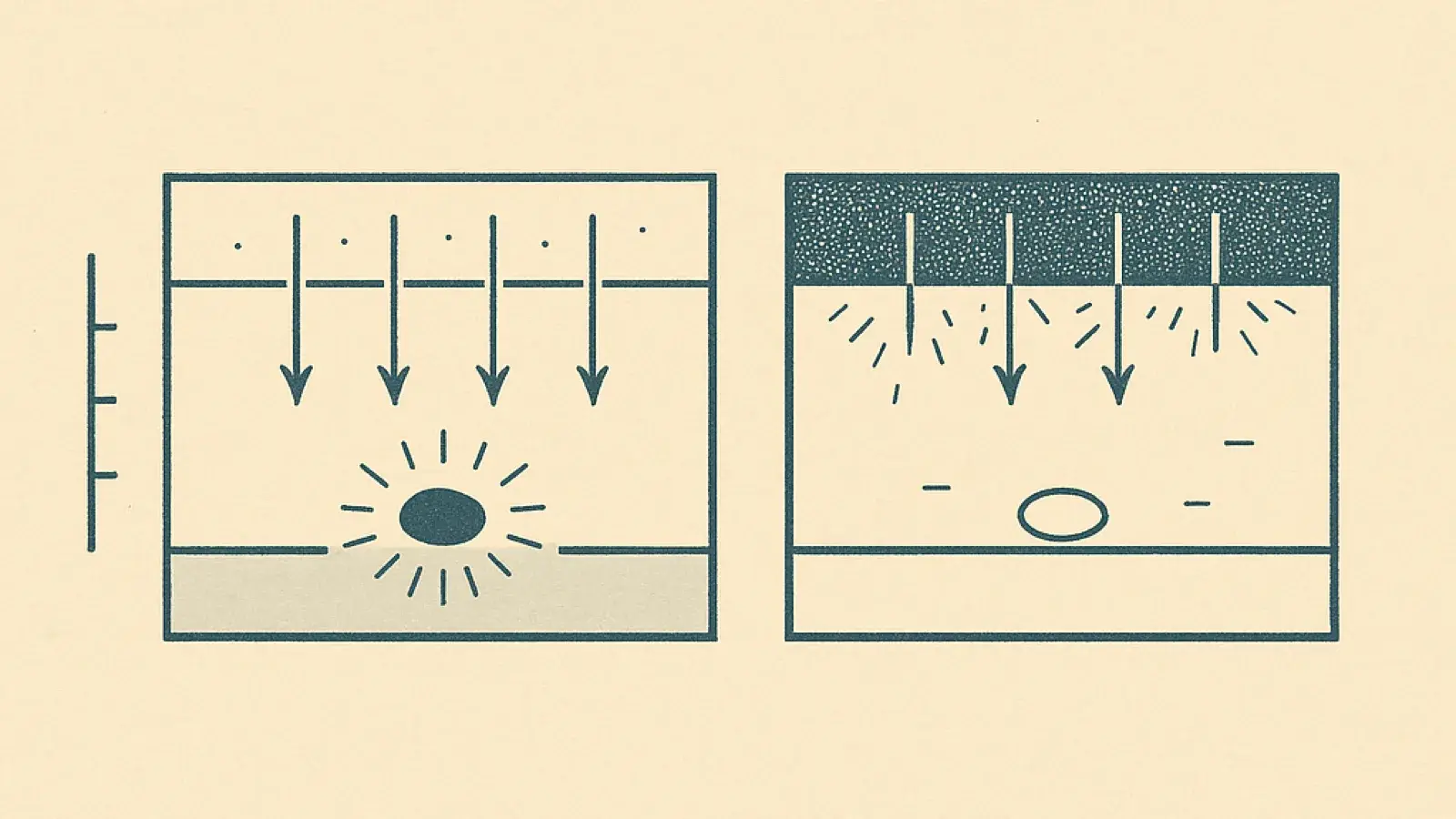
Treating a whole surface leaves a whole surface to heal. The 2004 paper that introduced fractional delivery drove energy into microscopic columns with untreated skin left between them, so healing runs inward from intact edges. It was small — prototypes on 15 subjects’ forearms and 30 more around the eyes — and its result modest: an 18% improvement in a wrinkle severity score at three months.
If separated columns are good, more must be better. The record does not support that. A 2007 study in Lasers in Surgery and Medicine examined pigment change after fractional resurfacing in Chinese patients (37 patients, 119 sessions): generalised post-inflammatory hyperpigmentation followed 7.1% of higher-energy, lower-density sessions and 12.4% of lower-energy, higher-density ones. The difference was not statistically significant, and the authors wrote only that density "may be of more important but further studies are necessary".
Ablative or non-ablative is a statement about water
The two words are sold as a measure of how strong a treatment is. They describe something else: whether water absorbs the wavelength strongly enough to boil tissue away rather than merely heat it. Water barely absorbs visible and near-infrared light and absorbs it enormously in the mid infrared (figure 1). So a device near 2,940 nanometres, or at the carbon dioxide wavelength of 10,600, vaporises tissue and leaves an open wound — that is what ablative means — while 1,550 nanometres, which water absorbs far more weakly, heats the dermis and largely spares the epidermis. Depth tracks absorption rather than the marketing category: a 2021 pilot study in Dermatology Research and Practice notes that 1,927 nanometres has "a higher coefficient for absorption of water compared with the 1,550 nm wavelength emitted by the same" device, which is why that wavelength is used on epidermal pigment and not on the dermis. Non-ablative does not mean deep, and it does not mean gentle. A 2008 review in the Journal of the American Academy of Dermatology states what the gentler methods traded away: "Neither nonablative nor fractional resurfacing produces results comparable to ablative laser skin resurfacing."
Intense pulsed light is not a laser, and that is the point
Intense pulsed light is a flash lamp: a broad band of wavelengths shaped by cut-off filters, not a single wavelength. Run that through the 1983 principle and several chromophores absorb from the same pulse. Selectivity is what the device trades for versatility, which makes it the least selective light source in ordinary aesthetic use. That is physics, not a verdict on any product.
Everything on this page depends on a chromophore existing. Devices that heat tissue without aiming at one — radiofrequency, focused ultrasound — obey a different set of rules, and are treated separately in what heat does to collagen.
"Cleared" is not "approved"
From the regulatory record
The route almost every aesthetic light device takes is 510(k) premarket notification. The manufacturer names an existing device — the predicate — and submits evidence of substantial equivalence: the same intended use, and either the same technological characteristics or different ones raising no new questions. When the United States Food and Drug Administration agrees, it issues a letter, and in FDA's words that order "'clears' the device for commercial distribution".
The other route is premarket approval, "the most stringent type of device marketing application required by FDA", which turns on valid scientific evidence that the device works for its stated use. Dermal fillers take it. Aesthetic lasers and flash lamps do not.
Dates: FDA, Premarket Notification 510(k), current 22 August 2024; Premarket Approval (PMA), current 16 May 2019.
FDA consumer update
current 4 May 2026
FDA puts it to consumers directly. Its page Is It Really 'FDA Approved'? says manufacturers of moderate-risk Class II devices "may market such devices pursuant to so-called '510(k) clearance,' allowing distribution once the manufacturer has demonstrated that the device is substantially equivalent to a legally marketed predicate device". A clearance is a statement about a resemblance, not a finding that the device does what the brochure says. The glossary entry carries the short form.
What that means if your skin is darker
Melanin sits mostly in the epidermis, so every device aimed at something deeper — a hair follicle, a dermal pigment deposit — has to send its light through it. A randomised trial in the British Journal of Dermatology in 2012 puts the mechanism in its opening line: "absorption of laser energy by the targeted hairs is compromised by an increased concentration of epidermal melanin."
Two things then go wrong at once. Less energy arrives where it was aimed, so the treatment works less well; more lands where it was not wanted, heating the epidermis. Turning the energy up worsens the second problem in the same proportion that it helps the first.
"The threshold incident light dosage for epidermal injury can be very close to the threshold for permanent removal of the target chromophore, thus precluding the use of higher light dosages."
Active skin cooling in conjunction with laser dermatologic surgery, Seminars in Cutaneous Medicine and Surgery, 2000. The window between enough to work and enough to burn narrows as epidermal pigment increases.Post-inflammatory hyperpigmentation — darkening of skin that has been inflamed or injured — is the commonest way that narrowed window shows up. It is not an allergy and not bad luck; it is pigment-producing cells responding to injury, in skin that has more of them. A 2024 narrative review in Lasers in Medical Science, covering complications in Fitzpatrick phototypes IV to VI from 1972 to 2023, frames it: "Limited experience with darker skin tones necessitates a higher level of laser expertise and a conservative approach." That is a statement about the field, not about a patient.
Cutis, 2020
PMID 32186531
Arch Dermatol, 1988
The measuring stick deserves its own caveat. The Fitzpatrick scale, published in the Archives of Dermatology in 1988, "was developed to assess the propensity of the skin to burn during phototherapy, but it also is commonly used by providers as means of describing constitutive skin color and ethnicity", a 2020 paper in Cutis notes. Every type V–VI figure below is therefore a sunburn-response category standing in for pigment: a workable proxy, not a measurement.
The levers the literature describes
What follows is reported as published findings, not as settings. The parameters that make any of it hold are a clinician's judgement about a particular person's skin.
Br J Dermatol, 2012 · PMID 21999492
JEADV, 2020 · PMID 31587390
Longer wavelengths. Melanin absorption falls as wavelength rises (figure 1), so light further into the near infrared passes through epidermal pigment more readily; 1,064 nanometres is where that logic lands for hair. In the 2012 trial already quoted, 50 women with Fitzpatrick types IV to VI were treated on one underarm with a long-pulsed 1,064-nanometre laser and on the other with intense pulsed light; of the 39 who completed, hair counts six months after the last of five sessions had fallen 79.4% on the laser side against 54.4% on the light side. A 2020 meta-analysis in the Journal of the European Academy of Dermatology and Venereology, pooling types III to VI, concluded that outcomes for the different in-office devices and intense pulsed light are "broadly similar" — with two departures worth naming. For hair count it was the alexandrite laser, not the 1,064-nanometre one, that beat intense pulsed light (standardised mean difference −1.7, 95% CI −2.6 to −0.78). On post-inflammatory hyperpigmentation the pooled estimate favoured the 1,064-nanometre laser over intense pulsed light, odds ratio 0.26 (95% CI 0.10–0.78). Those are the same figures the same paper reports as not statistically significant for hair count, which is a reason to hold the number loosely.
Dermatol Res Pract, 2021
PMID 33833793
Non-ablative fractional at 1,927 nanometres. Water absorbs this wavelength strongly enough to work on the upper skin without ablating it, which is why it is reported for epidermal pigment rather than for anything deeper. The published evidence is thin: the 2021 pilot study already quoted enrolled nine patients, all Fitzpatrick type IV, and could assess eight, one having been lost to follow-up; swelling and redness lasted five to seven days. Eight assessed patients of a single skin type is a starting point, not a finding.
J Dermatol, 2000 · PMID 11138535
Australas J Dermatol, 2025
Longer pulses and epidermal cooling travel together: the 2000 review notes that cooling "works far better with pulses longer than about 10 ms, delivered through a cold medium". Cooling is standard practice — and here the literature disagrees with itself. The 2007 study found localised pigment change in patients who had not received air cooling; a 2025 systematic review in the Australasian Journal of Dermatology reported the opposite, that cooling air devices "exacerbated the development of PIH". Both are real findings, measured in different settings, and nothing in the record reconciles them.
Arch Dermatol Res, 2025
PMID 40137990
Test spots. Treating a small area first and waiting to see what the skin does is widely described, and darker skin is the reason it is done. A 2025 survey of Association of Academic Cosmetic Dermatology members in Archives of Dermatological Research (66 respondents, 48.2% response rate) found "darker skin type" the top factor in that decision, named by 96.9%. Its authors close by underscoring "the importance of developing standardized protocols", which is a polite way of recording that there are none. Whether a test spot lowers the rate of lasting pigment change has not been established by a trial designed to answer it.
Where the evidence runs out
The physical principle is the firmest thing on this page. The clinical result in lighter skin rests on a large but uneven trial literature, mostly small and single-centre; the result in darker skin is weaker than both. A demonstrated tissue effect is not a demonstrated benefit: that a wavelength reliably heats a chosen structure says nothing about how often something goes wrong in skin unlike the skin in the trial.
Australas J Dermatol, 2025
PMID 39953770
The clearest measurement of the gap is in that 2025 review. Searching MEDLINE from 1946 and Embase from 1974 for anything on preventing post-inflammatory hyperpigmentation in skin of colour, its authors screened 3,205 records and finished with 14 studies covering 369 patients. Every patient was of Asian ethnicity; 42% were Fitzpatrick type III, 54% type IV, 4% type V. Type VI: none. Ninety-five per cent of the cases under study had been caused by laser treatment in the first place. Only sunscreen consistently prevented it arising; the same review describes photoprotection as standard care after laser for every skin tone, and as something to practise for at least two weeks beforehand as well.
The hair-removal literature is not much deeper. The 2020 meta-analysis assembled the whole comparative base for in-office laser and intense pulsed light across Fitzpatrick types III to VI and found twelve eligible trials — nine randomised, three quasi-randomised.
The gap is the finding, not a caveat attached to a recommendation, because there is no recommendation here. Where the trial base in types V and VI is a fraction of the base in types I to III, a manufacturer's protocol claim for darker skin is an extrapolation, and so is a clinic's.
JAMA Dermatol, 2014
Dermatol Surg, 2022 · PMID 35013046
One further variable cannot be read from outside. A review in JAMA Dermatology in 2014 identified 175 cases of injury from cutaneous laser procedures between January 1999 and December 2012; an update in Dermatologic Surgery searching the same legal database found 69 more between 2012 and 2020, of which 36 had a discernible outcome and 19 ended in a judgement for the plaintiff. Those are counts of lawsuits rather than of injuries, and a poor denominator, but they are evidence that these devices injure people. How much experience the operator has with skin like yours appears on no label, in no clearance letter and in no price.
What it costs, and how it is priced
The unit is the session, and the session is the wrong unit. These treatments are sold per session and per treatment area, with prepaid multi-session deals and monthly billing arrangements common. Because the eventual number of sessions is the largest term in the total and is not knowable in advance, a per-session figure from two places is not a comparable number.
One published national figure. The American Society of Plastic Surgeons gives an average cost for laser skin resurfacing of $1,829, noting that this "average cost is only part of the total price – it does not include other related expenses". Its page carries no year for the statistic, which limits the weight it can hold.
What the physics adds. The literature above describes darker skin being treated more conservatively and over more sessions, so the course costs more than the per-session price suggests.
Risks and side effects
Common
Redness, swelling and discomfort, resolving over days. The 2021 pilot study reported five to seven days of swelling and redness; the 2012 hair-removal trial reported temporary adverse effects on both treated sides. Ablative treatment leaves an open wound, and by the 2008 review's account it was the "prolonged 2-week recovery time and small but significant complication risk" of ablative resurfacing that prompted the gentler methods to be developed at all.
Less common
Post-inflammatory hyperpigmentation, more likely as skin pigment increases: 7.1% and 12.4% of sessions in the two treatment patterns of the 2007 series, and, in the earlier literature the 2025 systematic review summarises, an incidence of 10–20% among people with skin of colour undergoing laser therapy. That review's own line on how far technique can help is the one to keep: proper delivery of laser energy "can mitigate but not fully eliminate the risk of PIH". The United States Food and Drug Administration's own list, on its Medical Lasers page, is shorter and blunter — the risks of laser surgery "include incomplete treatment of the problem, pain, infection, bleeding, scarring, and skin color changes".
Rare but serious
Burns, scarring and permanent loss of pigment. Nothing cited on this page establishes how often they happen: what gets counted is lawsuits, or adverse events inside trials of a few dozen people, which is too few to measure a rare event. What is not in doubt is that these are the outcomes that do not reverse. The 2024 review of complications in phototypes IV to VI exists because the category is not theoretical in darker skin; its call for "a higher level of laser expertise and a conservative approach" answers the size of the downside rather than its frequency. A complication that cannot be undone is a different proposition from one that fades.
Can it be undone
Partly, and it depends on which thing happened and on how deep the pigment went. A 2010 review in the Journal of Clinical and Aesthetic Dermatology separates the two cases: hyperpigmentation held in the epidermis looks tan to dark brown and "may take months to years to resolve without treatment", while pigment that has dropped into the dermis looks blue-grey and "may either be permanent or resolve over a protracted period of time if left untreated". Scarring and permanent loss of pigment do not reverse at all, and there is no equivalent here of the enzyme used against hyaluronic acid filler: once tissue has been heated, nothing takes the heat back out.
When to seek urgent care
If this is happening now
Blistering, an open or weeping area, skin that turns white or grey, spreading redness with heat or fever, pus, or pain that is increasing rather than settling after a light-based treatment are described in the medical literature as findings clinicians treat urgently. Seek medical care now rather than waiting to see — in the United States, an emergency department, or 911 for anything severe or fast-moving. This page cannot tell you what is happening to your skin. Afterwards, the official complaint channels are set out at where to report.
Questions the record supports asking
- Which wavelength does this device use, and which absorber is it aimed at?
- Is it FDA-cleared or FDA-approved, and for what stated use?
- How many people with skin like mine has this clinician treated with it?
- Will a test area be treated first, and how long will it be watched?
- How many sessions does the plan assume, and what is the total cost across them?
- What happens if post-inflammatory hyperpigmentation develops, and is that follow-up included?
- Which of the possible outcomes here are permanent?
- Who will operate the device on the day, and what training and supervision do they have?
Alternatives, including doing nothing
Doing nothing is a real option and the only one with no risk of a burn, a scar or a lasting pigment change. Unwanted hair, uneven pigment and photoageing are not diseases.
Otherwise the alternatives depend on the target. For hair: shaving, waxing, threading, depilatory creams, and electrolysis, which destroys follicles one at a time with an electric current and so does not depend on a pigment target at all. Each has its own irritation and pigment-change risk in darker skin, but not the risk of a beam-delivered burn. Pigment is a different case, and the 2025 review is easy to over-read: it measured what stops a procedure causing pigment change, not what removes pigment already there. On that question its one consistent finding was sunscreen.
Whether any of this suits you depends on your medical history, the medicines you take, and how your skin has responded to injury before. Establishing that is what a consultation with a licensed clinician is for. The full register of treatments is on the front page.
Sources
- Anderson RR, Parrish JA. Selective photothermolysis: precise microsurgery by selective absorption of pulsed radiation. Science 1983;220(4596):524–527. PMID 6836297.
- Anderson RR. Lasers in dermatology — a critical update. Journal of Dermatology 2000;27(11):700–705. PMID 11138535.
- Nelson JS, Majaron B, Kelly KM. Active skin cooling in conjunction with laser dermatologic surgery. Seminars in Cutaneous Medicine and Surgery 2000;19(4):253–266. PMID 11149606.
- Manstein D, Herron GS, Sink RK, Tanner H, Anderson RR. Fractional photothermolysis: a new concept for cutaneous remodeling using microscopic patterns of thermal injury. Lasers in Surgery and Medicine 2004;34(5):426–438. PMID 15216537.
- Chan HH, Manstein D, Yu CS, Shek S, Kono T, Wei WI. The prevalence and risk factors of post-inflammatory hyperpigmentation after fractional resurfacing in Asians. Lasers in Surgery and Medicine 2007;39(5):381–385. PMID 17518354.
- Alexiades-Armenakas MR, Dover JS, Arndt KA. The spectrum of laser skin resurfacing: nonablative, fractional, and ablative laser resurfacing. Journal of the American Academy of Dermatology 2008;58(5):719–737. PMID 18423256.
- Davis EC, Callender VD. Postinflammatory hyperpigmentation: a review of the epidemiology, clinical features, and treatment options in skin of color. Journal of Clinical and Aesthetic Dermatology 2010;3(7):20–31. PMID 20725554.
- Ismail SA. Long-pulsed Nd:YAG laser vs. intense pulsed light for hair removal in dark skin: a randomized controlled trial. British Journal of Dermatology 2012;166(2):317–321. PMID 21999492.
- Jacques SL. Optical properties of biological tissues: a review. Physics in Medicine and Biology 2013;58(11):R37–R61. PMID 23666068.
- Jalian HR, Jalian CA, Avram MM. Increased risk of litigation associated with laser surgery by nonphysician operators. JAMA Dermatology 2014;150(4):407–411. PMID 24132614.
- Dorgham NA, Dorgham DA. Lasers for reduction of unwanted hair in skin of colour: a systematic review and meta-analysis. Journal of the European Academy of Dermatology and Venereology 2020;34(5):948–955. PMID 31587390.
- Ware OR, Dawson JE, Shinohara MM, Taylor SC. Racial limitations of Fitzpatrick skin type. Cutis 2020;105(2):77–80. PMID 32186531.
- Alharbi MA. 1927 nm thulium laser successfully treats post-inflammatory hyperpigmentation in skin of color. Dermatology Research and Practice 2021;2021:5560386. PMID 33833793.
- Khalifian S, Vazirnia A, Mohan GC, Thompson KV, Jalian HR, Avram MM. Causes of injury and litigation in cutaneous laser surgery: an update from 2012 to 2020. Dermatologic Surgery 2022;48(3):315–319. PMID 35013046.
- Soares I, Amaral IP, Correia MP, Travassos R, Filipe P. Complications of dermatologic lasers in high Fitzpatrick phototypes and management: an updated narrative review. Lasers in Medical Science 2024;39(1):149. PMID 38834924.
- Mar K, Maazi M, Khalid B, Ahmed R, Wang OJE, Khosravi-Hafshejani T. Prevention of post-inflammatory hyperpigmentation in skin of colour: a systematic review. Australasian Journal of Dermatology 2025;66(3):119–126. PMID 39953770.
- Wang JY, Patel P, Kabakova M, Cohen M, Jagdeo J. Factors influencing laser test spot practices among dermatologists: a cross-sectional survey of the Association of Academic Cosmetic Dermatology members. Archives of Dermatological Research 2025;317(1):633. PMID 40137990.
- Fitzpatrick TB. The validity and practicality of sun-reactive skin types I through VI. Archives of Dermatology 1988;124(6):869–871. PMID 3377516.
- US Food and Drug Administration, Premarket Notification 510(k), content current 22 August 2024.
- US Food and Drug Administration, Premarket Approval (PMA), content current 16 May 2019.
- US Food and Drug Administration, Is It Really 'FDA Approved'?, content current 4 May 2026.
- US Food and Drug Administration, Medical Lasers, content current 3 August 2023.
- American Society of Plastic Surgeons, Laser skin resurfacing cost. The page carries no year for the figure.
Reviewed: 8 August 2026 · Evidence current to: 8 August 2026