Radiofrequency, ultrasound and microneedling: what heat does to collagen, and what “lift” is actually measuring
On 15 October 2025 the US Food and Drug Administration told patients and clinicians it had received reports of burns, scarring, fat loss, disfigurement and nerve damage after radiofrequency microneedling, some needing surgical repair. Five months later a review of the agency’s own postmarketing database counted fat loss in 26 of 224 reported events. The treatments here share one physical event — protein is heated until it comes apart — and the clinical literature behind them is the thinnest on this site.
What it actually is
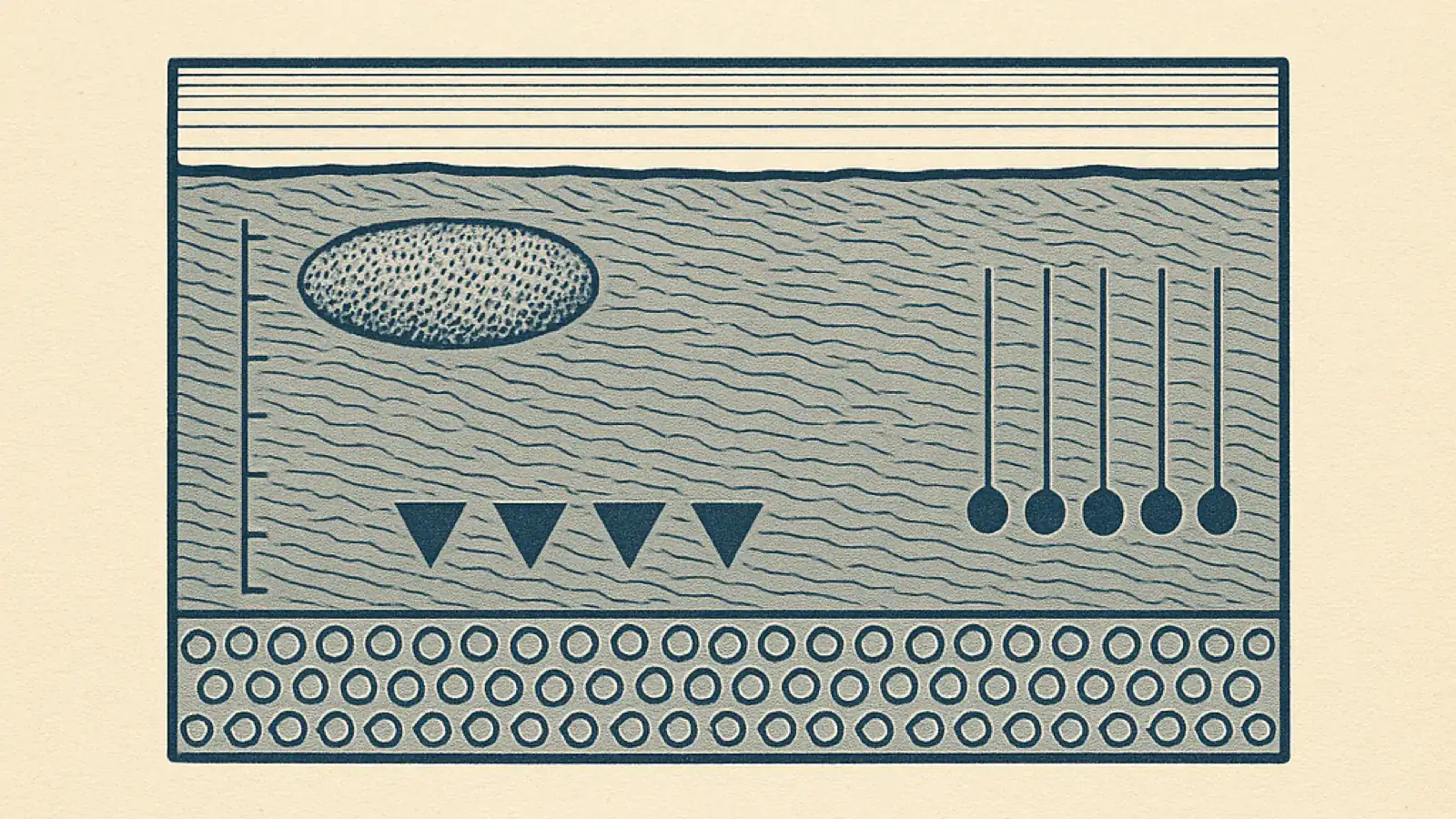
Four things are sold as tightening. Three deliver heat by different physics; the fourth delivers no energy at all.
Radiofrequency
FDA, Potential Risks with Certain Uses of Radiofrequency (RF) Microneedling, 15 Oct 2025
Radiofrequency heats tissue from the inside: an alternating current is driven through it, the tissue resists, and resistance makes heat. FDA’s wording is that “radiofrequency (RF) energy is a type of electrical energy that creates heat in tissues”. Nothing in that sentence depends on a pigment. Light-based treatments must find a chromophore that absorbs the chosen wavelength, and in darker skin epidermal melanin competes for energy meant for something deeper (how light-based treatments choose a target). Current heats what conducts instead, so that problem does not arise in the same form. It is a real advantage of the physics — in mechanism, not in outcomes: a 2024 review in the Journal of Clinical and Aesthetic Dermatology of energy-based devices in Fitzpatrick types III to VI assembled 7 randomised trials, 14 prospective cohorts and 6 retrospective reviews, and named the shortage of type VI participants as its own limitation.
Microfocused ultrasound
Ultrasound does the opposite of spreading energy out: a transducer focuses sound waves to a point at a set depth, and only at that focus is enough absorbed to coagulate tissue. In six unfixed human cadaveric specimens, 202 exposure lines produced reproducible thermal injury zones in the SMAS at depths up to 7.8 mm, sparing the layers above including the epidermis (Archives of Facial Plastic Surgery, 2007); a companion study on postmortem human skin made confined, inverted-cone lesions up to 4 mm deep in the dermis (Dermatologic Surgery, 2008). So the treated volume is a grid of coagulated points with untreated tissue between them, not a heated sheet — the logic of fractional delivery.
Radiofrequency microneedling
Here the electrodes are needles. FDA describes an “array of small electrodes (tiny, sharp needle-like projections also known as microneedles)” delivering energy so that “each microneedle produces a small area of intense heat at its tip”. The needles put heat past the epidermis rather than through it, so the surface can look comparatively untouched over a column of coagulated tissue — and the depth setting decides which layer is injured, including layers nobody intended to treat.
Microneedling without energy
Plain microneedling adds no heat. It is controlled injury and nothing else, which the regulation says out loud: 21 CFR 878.4430, Microneedling device for aesthetic use, defines one as “a device using one or more needles to mechanically puncture and injure skin tissue for aesthetic use”, and adds that the classification “does not include devices intended for transdermal delivery of topical products such as cosmetics, drugs, or biologics”. The treatment is the wound, and what is claimed downstream depends on how that wound heals.
What heat does to collagen
J Am Acad Orthop Surg 2000;8(5):305–13
A collagen molecule is three chains wound around each other and held by hydrogen bonds. Heat it enough and those bonds break, the helix unwinds, and the fibre contracts along its length. A basic-science review in the Journal of the American Academy of Orthopaedic Surgeons put the temperatures that alter collagen’s molecular bonding and cause shrinkage at 65 °C to 70 °C — and noted in the same sentence that those temperatures “are also known to destroy cellular viability”. Shrinkage and cell death arrive together. Thermally modified tissue is devitalised and must be rebuilt by the body, which is why that review judged the technique’s likely value to be “as a stimulant for inducing a biologic repair response” rather than a way of shrinking tissue directly.
Arch Dermatol 2004;140(2):204–9
Skin behaves the same way, though the evidence is thinner than that sentence suggests. A 2004 pilot study in Archives of Dermatology treated bovine tendon and human abdominal skin with a monopolar radiofrequency device. In tendon, collagen fibrils showed increased diameter and loss of their distinct borders as deep as 6 mm. In human skin, light microscopy found no significant change immediately afterwards, nor at three and eight weeks; only electron microscopy picked up scattered altered fibrils, alongside an increase in type I collagen messenger RNA. The authors read that as immediate fibril contraction plus a thermal wound that induces new collagen.
Which inverts the marketing story. The instant tightening is small and patchy; the months of repair that follow — neocollagenesis and remodelling — are most of whatever result appears, and an effect that is a healing response varies with the person healing.
Fat is heated too
Lasers Surg Med 2010;42(5):361–70
Fat gives out well before collagen does. A 2010 feasibility study in Lasers in Surgery and Medicine set out to destroy subcutaneous fat deliberately with radiofrequency, and measured the thresholds: cultured adipocyte viability fell from 89% to 20% when one-minute exposures rose from 45 °C to 50 °C, and three minutes at 45 °C left 40% viable. In abdominoplasty patients, adipose tissue at 7–12 mm depth reached 50 °C while the skin above stayed below 30 °C, and histology showed vascular changes from day 4 and fat necrosis from day 9.
That paper is a device study, written to show fat can be destroyed selectively through intact skin. It establishes the physiology all the same: adipocytes die well below the temperatures collagen needs, and the damage declares itself over days rather than at the appointment. Those two findings sit under the fat-loss reports counted below, though FDA’s safety communication states no mechanism and that paper studied a different device on the abdomen, not needles on a face. What the temperatures do establish is that a treatment aimed at collagen passes through a range in which fat does not survive, and that facial fat compartments are thin and structural, so a loss there shows as a change in contour.
What it is approved for
From the regulatory record
Microfocused ultrasound. Authorised through the De Novo route on 11 September 2009 (DEN080006), which created the Class II classification at 21 CFR 878.4590, Focused ultrasound stimulator system for aesthetic use; FDA files it under the device classification name “focused ultrasound for tissue heat or mechanical cellular disruption”, product code OHV. The 510(k) summary for the clearance decided on 20 June 2014 (K134032) lists the indications: “lift the eyebrow”, “lift lax submental (beneath the chin) and neck tissue”, “improve lines and wrinkles of the décolleté”.
Radiofrequency microneedling. Class II devices cleared through the 510(k) route, per FDA’s safety communication of 15 October 2025.
Microneedling. FDA “has legally authorized microneedling devices to improve the appearance of facial acne scars, facial wrinkles, and abdominal scars in patients aged 22 years or older”, for specified areas only; the pathway is in its final guidance Regulatory Considerations for Microneedling Products, November 2020.
Not authorised, explicitly. Microneedling devices “are not approved for delivery of cosmetics, topical medications (for example, creams, ointments, gels), vitamin solutions, drugs, or blood products (for example, platelet-rich plasma (PRP)) into the skin”. Anything driven into the channels is a separate question, taken up in injectables with no US approval.
Those sentences sit on the top rung of this site’s certainty scale, because they quote the regulatory record. But read what the rung covers: almost every device here reached the market by clearance rather than approval — a finding of substantial equivalence to something already marketed, not a finding that it works. “Cleared to lift the eyebrow” describes an authorised claim, not a measurement.
What the evidence establishes
J Am Acad Dermatol 2010;62(2):262–9
Start with the measurement behind the word lift. A rater-blinded prospective cohort study in the Journal of the American Academy of Dermatology in 2010 treated the full face and neck with focused ultrasound and evaluated 35 people. Three masked assessors judged 30 of the 35 (86%) to show a clinically significant brow lift at 90 days, and the objective outcome — mean change in eyebrow height against fixed landmarks — was 1.7 mm. Lower-face tightening could not be quantified at all, for want of landmarks. That figure is real and blindly assessed. It is also less than two stacked coins, sitting under a word that in ordinary use describes surgery.
Lasers Med Sci 2025;40(1):169
A 2025 systematic review with meta-analysis in Lasers in Medical Science searched five databases for microfocused ultrasound in sagging skin. After duplicates were removed, 118 articles were identified, 99 were assessed for eligibility, and 12 were usable — three randomised and nine not, 475 participants in all. Only two could be pooled, and that comparison, of neck sagging, found no significant difference between ultrasound and radiofrequency at short, medium or long-term follow-up. A field producing 118 candidate papers and three randomised trials is telling you what kind of field it is.
Aesthetic Plast Surg 2026;50(13):5282–5317 · J Cosmet Dermatol 2026;25(4):e70845
For radiofrequency microneedling, the two largest recent syntheses appeared in 2026. One, in Aesthetic Plastic Surgery, included 41 studies (15 randomised), found scar scores fell consistently in atrophic acne scarring, comparably to fractional lasers, and recorded that reporting of temperature, pulse width and cooling was inconsistent. The other, in the Journal of Cosmetic Dermatology, synthesised 20 studies with 558 participants and reported adverse events as predominantly mild and transient, with no serious complications in the studies included. Both list authors employed by or speaking for a device manufacturer — which does not invalidate them, and belongs in the sentence that cites them.
Cochrane Database Syst Rev 2016;4:CD011946
Acne scarring is where needling has the most trial support, and two reviews read that support differently. A Cochrane review of 24 randomised trials in 789 adults graded almost every comparison as very low-quality evidence — the one exception was injectable filler against placebo, rated moderate — and concluded that its results “do not provide support for the first-line use of any intervention in the treatment of acne scars”, needling included. Its searches stopped in November 2015, which is before most of the radiofrequency-needling literature existed, so it is evidence about needling and peels and lasers rather than a verdict on the newer devices. A 2026 network meta-analysis in Aesthetic Plastic Surgery, restricted to moderate-to-severe atrophic acne scars, pooled 56 randomised trials and 1,488 patients and found combination treatments generally outranked single ones, while noting that most participants were in split-face or self-controlled studies and calling for larger long-term trials.
Where the evidence runs out
All of the above is tissue science: collagen denatures, fibrils contract, new collagen is transcribed. None of it is in dispute, and none of it establishes a clinical benefit in a person’s face.
Four gaps, stated plainly.
- What “lift” denotes. The word appears in FDA-cleared indications, so it is not purely a marketing invention — but the objective measurement offered for it is 1.7 mm of mean brow elevation at 90 days in 35 people.
- Durability. Follow-up here is usually months, and it is not clear whether measured change persists beyond the study windows, because studies long enough to answer have not been done.
- Settings. Where trials do not report temperature, pulse width and cooling, a clinic using the same brand is not necessarily doing the same thing.
- Combinations. Stacking ultrasound, radiofrequency, needling, toxin and filler in one course is commercially common and almost unstudied. It has not been evaluated in controlled clinical studies.
One absence shapes the section below: there is no denominator. Nobody counts how many of these procedures are performed in the United States, so no reported injury can be turned into a rate. The honest reassurance and the honest alarm are both unavailable.
What it costs, and how it is priced
Quotes use three units, and the units do not compare. Per session hides how many sessions the plan assumes. Per area hides intensity: a light pass and a heavy one over the same zone are one line on an invoice. Per line or per pass, used for focused ultrasound, counts energy deliveries, so two quotes for one region can differ several-fold and both be accurate. Needling adds a consumable, since FDA states that re-use of the needle cartridge “is unsafe and is not consistent with the FDA’s review and authorization, even if the cartridge is cleaned”. How prices are built is set out separately.
Risks and side effects
Common
FDA’s list of common risks for microneedling is dryness, rough skin, tightness, redness, itching, peeling, discomfort, burning, bruising, bleeding and crusting. Most reported adverse events here are of that kind: erythema and oedema for a few days, then resolution.
Less common
FDA lists pigmentation changes in either direction, lines on the face, reactivation of herpes cold sores, swollen lymph nodes, infection, and stinging or itching when cosmetic products are applied. The same page states that some side effects “may be permanent”, and that the risks of off-label uses, of combining these devices with other products, and of products FDA has never evaluated “are not known”.
Dermatol Surg, March 2026 · MAUDE 2013–2025
Postmarketing data gives that tier its shape. A retrospective review in Dermatologic Surgery in March 2026, by a group at Massachusetts General Hospital, read FDA’s MAUDE database from January 2013 to October 2025 and found 114 reports containing 224 adverse events for radiofrequency microneedling: textural changes (56 events, 25.0%), pigmentary alteration (41, 18.3%), fat loss (26, 11.6%), inflammatory reactions (18, 8.0%), burns (14, 6.3%) and pain (12, 5.4%). The face, neck and abdomen were the most treated regions in those reports, which is not the same as the sites where events were most likely. Those percentages are shares of reported events, not risks to a patient — MAUDE is voluntary, under-counts by design, and has no denominator. What it establishes is the spectrum, and it is not confined to redness.
Rare but serious, and sometimes permanent
“With use of these devices for dermatologic or aesthetic procedures intended to improve the appearance of the skin (to treat wrinkles or to achieve skin effects, sometimes referred to as resurfacing, ‘tightening’ or ‘rejuvenation’), the FDA is aware of reports of serious complications (adverse events) including burns, scarring, fat loss, disfigurement, and nerve damage, and the need for surgical repair or medical intervention to treat injuries.”
FDA Safety Communication, Potential Risks with Certain Uses of Radiofrequency (RF) Microneedling, 15 October 2025Those items differ in whether they end. A scar is permanent by definition, though its appearance can be modified later. Lost facial fat does not grow back, and the deficit is a change in contour rather than a mark on the surface. Nerve involvement is in the peer-reviewed record too: a 2020 case report in Dermatologic Surgery described temporary greater auricular nerve paraesthesia after radiofrequency microneedling, and FDA’s wording is broader than that single case, extending to the need for surgical repair. The agency also states that “RF microneedling is a medical procedure, not a cosmetic treatment, and these devices should not be used at home.”
Who FDA says the procedure may not suit
FDA’s microneedling page carries something unusual for an aesthetic device: a published list of people for whom it says the procedure “may NOT be suitable”. It covers a known history of clotting or bleeding disorders such as haemophilia; immune deficiency or immune suppression from a condition or a medicine; uncontrolled diabetes; anticoagulant therapy including warfarin, heparin or low-dose aspirin; active bacterial, viral or fungal skin infection; hepatitis or HIV infection; eczema, psoriasis, vitiligo or autoimmune disease, current or past; an active facial rash; a current cold sore outbreak; isotretinoin taken now or within the past six months; actinic keratoses, keloid scars or a history of them, warts, birthmarks or moles in the treatment area; darker skin type, “as there is a risk of darkening or lightening of the skin after the procedure”, with FDA adding that some authorised devices “were not studied in subjects with darker skin types”; being tanned or planning sun exposure in the fortnight afterwards; a known malignancy, or chemotherapy, radiotherapy or steroid treatment under way or about to start; pregnancy or breastfeeding; and allergy to stainless steel or to topical or local anaesthetics.
That list is FDA’s, written for microneedling devices. It is a description of the record, not a screening tool, and it does not tell anyone whether they are in one of those groups — several of the items are diagnoses. No comparable published list exists for microfocused ultrasound or for radiofrequency tightening, which is itself a gap rather than a reassurance.
Can it be undone
No. No product is approved to reverse a thermal injury, and none to replace lost fat. Hyaluronic acid gel can be dissolved because an enzyme cleaves it; heat leaves nothing to dissolve. What exists is correction — filler, fat grafting, scar revision, surgery — each a further procedure with its own risks, and none a return to the starting point.
When to seek urgent care
Seek urgent medical care
FDA publishes no list of warning signs for these devices. What its October 2025 safety communication says is: “If you experience any problems or are concerned after a skin procedure using RF microneedling, seek care from a licensed health care provider.” Its microneedling page tells providers to know the signs and symptoms of complications, to hold a plan for treating them that may include immediate referral, and to tell patients “that they should seek immediate medical attention if they experience signs or symptoms of complications”.
The complications FDA names are burns, scarring, fat loss, disfigurement and nerve damage, and its risk list for microneedling includes infection. Injuries of that kind are recognised clinically as blistering or an open or weeping wound, spreading redness with heat, fever or discharge, pain that increases rather than settles, and new numbness, weakness or loss of movement in the treated area. This page cannot tell you what is happening to your skin. If something like that is happening, seek medical care now rather than waiting — in the United States, an emergency department, or 911 for anything severe or fast-moving. Afterwards, FDA asks patients and clinicians to report complications from these devices through the MedWatch voluntary reporting form; the routes are listed at where to report.
Questions the record supports asking
- Which device, by name, and what has FDA authorised it to do? The 510(k) and De Novo databases are public and state the indication.
- Is what is proposed an authorised use, or off-label? FDA states the risks of unevaluated uses are not known.
- How many sessions does the plan assume, and what does the course cost rather than the first session?
- What is being measured to decide whether it worked, at what interval, and by whom?
- How much of the published evidence for this device is in Fitzpatrick skin types V and VI?
- Is a new sterile needle cartridge opened for this session? FDA states that re-use of the needle cartridge is unsafe and is not consistent with its review and authorisation, even if the cartridge is cleaned.
- If fat loss, a burn or altered sensation appeared afterwards, who would assess it, and where?
Alternatives, including doing nothing
Doing nothing has a knowable consequence: laxity progresses with age either way, and no trial here compares these devices against waiting over the timescales people care about. That counterfactual is unmeasured, which is worth knowing before paying for a course.
The other options are not interchangeable. Surgical lifting works at a different magnitude with a different risk profile, and no study cited here compares the two directly. For moderate-to-severe atrophic acne scarring, the 2026 network meta-analysis set 34 interventions against each other — lasers, needling, radiofrequency needling, peels, subcision, fillers and combinations — and ranked combinations above single treatments, which is an argument about sequencing rather than an endorsement of a device.
Whether any of this suits you depends on your medical history, the medicines you take and what the skin in that area is doing. Establishing that is what a consultation with a licensed clinician is for.
Sources
- US Food and Drug Administration. Potential Risks with Certain Uses of Radiofrequency (RF) Microneedling — FDA Safety Communication. Date issued 15 October 2025; content current as of 15 October 2025.
- US Food and Drug Administration. Microneedling Devices. Authorised uses, the risk lists and the cartridge advice quoted above.
- US Food and Drug Administration. Regulatory Considerations for Microneedling Products. Final guidance, November 2020, docket FDA-2017-D-4792.
- 21 CFR 878.4430, Microneedling device for aesthetic use (FDA product code QAI, “powered microneedle device”), and 21 CFR 878.4590, Focused ultrasound stimulator system for aesthetic use, added at 76 FR 43121, 20 July 2011 (FDA product code OHV, “focused ultrasound for tissue heat or mechanical cellular disruption”).
- US Food and Drug Administration. De Novo DEN080006, decision date 11 September 2009, and the 510(k) summary for K134032, decision date 20 June 2014 — the cleared indications quoted above.
- Thermal modification of connective tissues. Journal of the American Academy of Orthopaedic Surgeons, 2000;8(5):305–13. PMID 11029558.
- Histological and ultrastructural evaluation of the effects of a radiofrequency-based nonablative dermal remodeling device: a pilot study. Archives of Dermatology, 2004;140(2):204–9. PMID 14967794.
- Selective creation of thermal injury zones in the superficial musculoaponeurotic system using intense ultrasound therapy: a new target for noninvasive facial rejuvenation. Archives of Facial Plastic Surgery, 2007;9(1):22–9. PMID 17224484.
- Intense focused ultrasound: evaluation of a new treatment modality for precise microcoagulation within the skin. Dermatologic Surgery, 2008;34(5):727–34. PMID 18429926.
- Ultrasound tightening of facial and neck skin: a rater-blinded prospective cohort study. Journal of the American Academy of Dermatology, 2010;62(2):262–9. PMID 20115948.
- Hyperthermic injury to adipocyte cells by selective heating of subcutaneous fat with a novel radiofrequency device: feasibility studies. Lasers in Surgery and Medicine, 2010;42(5):361–70. PMID 20583242.
- Systematic review and meta-analysis — microfocused ultrasound treatment for sagging skin. Lasers in Medical Science, 2025;40(1):169. PMID 40167815.
- Effectiveness of radiofrequency microneedling in dermatological conditions: a systematic review. Aesthetic Plastic Surgery, 2026;50(13):5282–5317. PMID 42047762. Declarations include employment by and speaking arrangements with a device manufacturer.
- Radiofrequency Microneedling for Facial Rejuvenation: A Systematic Review. Journal of Cosmetic Dermatology, 2026;25(4):e70845. PMID 41947517. Same declaration applies.
- Analysis of US Food and Drug Administration data on radiofrequency microneedling device complications. Dermatologic Surgery, online 18 March 2026. PMID 41886649.
- Interventions for acne scars. Cochrane Database of Systematic Reviews, 2016, issue 4, CD011946; searches to November 2015. Full text.
- Laser, microneedling, and combination therapies for moderate to severe acne atrophic scars: a systematic review and network meta-analysis. Aesthetic Plastic Surgery, online 10 July 2026. PMID 42429955.
- Energy-based devices for the treatment of facial skin conditions in skin of color. Journal of Clinical and Aesthetic Dermatology, 2024;17(6):22–32. PMID 38912197.
- Temporary greater auricular nerve paraesthesia after radiofrequency microneedling. Dermatologic Surgery, 2020;46(9):1250–1252. PMID 31415256.
Reviewed: 8 August 2026 · Evidence current to: 8 August 2026