How these treatments are priced, and why two quotes do not compare
A price per unit and a price per area cannot be compared, and neither can two per-unit prices for different botulinum toxin brands, because a unit is defined by each manufacturer’s own potency assay. The number that looks lower is frequently attached to less product, or to a quantity nobody has stated. The cheaper quote can be the larger bill.
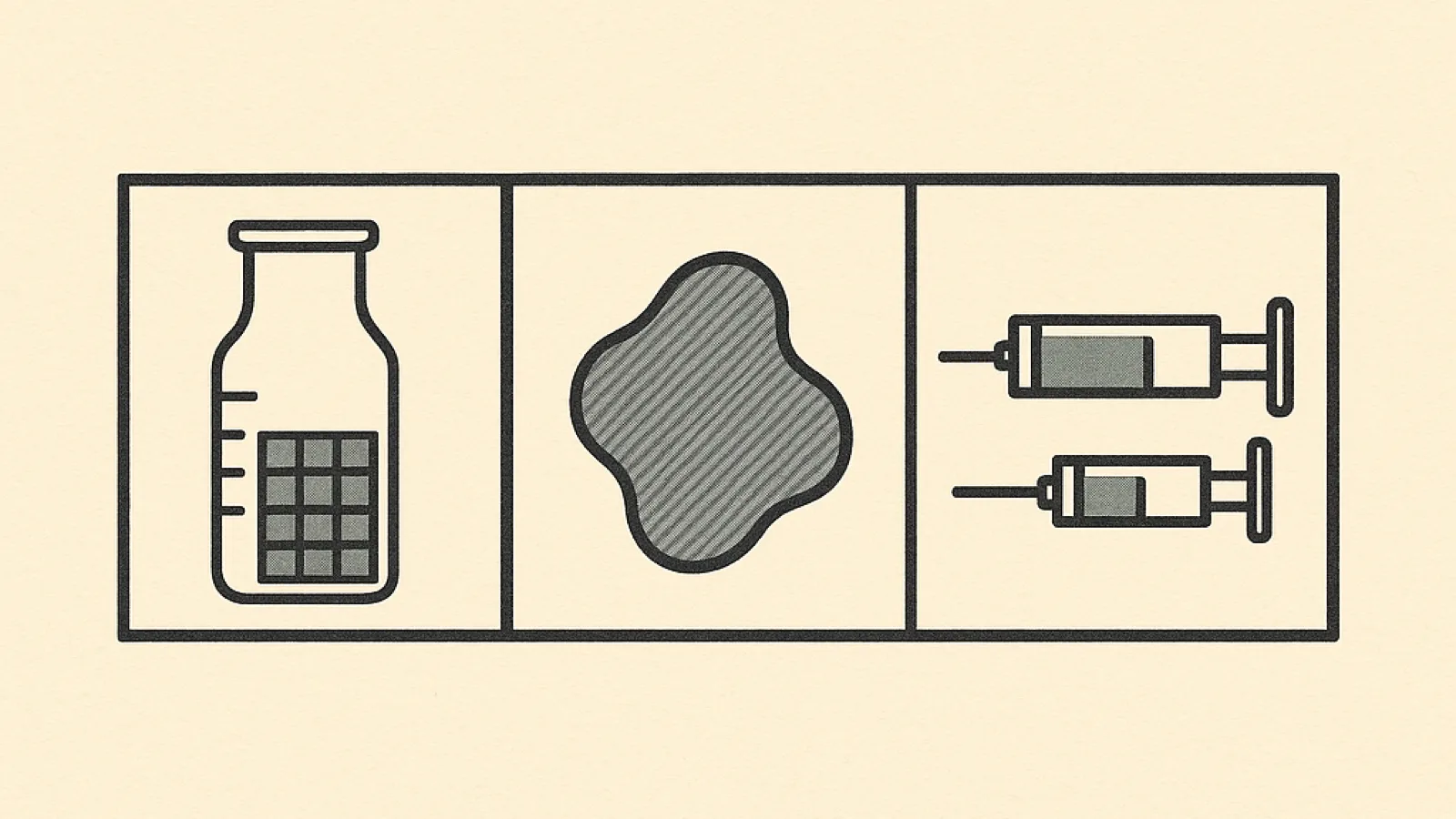
What a quote actually describes
Three ways of pricing are in general use, and each decides what gets written down, and therefore what can be checked afterwards.
Per unit applies to botulinum toxin, and it is the only arrangement that records the amount of drug used. Its limit is written into the approved labelling. A Unit is not a weight or a volume; it is defined by each manufacturer’s own potency assay, and the BOTOX Cosmetic prescribing information states that units of one product cannot be compared with, or converted into, units of any other assessed by any other assay method. Two clinics quoting per unit are quoting in different currencies unless the vial is the same brand — how that unit is defined has its own article here.
Per area — a price for “the forehead”, “the frown lines”, “the upper face” — removes the quantity from the transaction altogether. The same number is charged whether a light amount or a full one is used, and nothing in the paperwork afterwards distinguishes the two. That matters most when the result underwhelms, because the two candidate explanations — too little product, or a muscle that responded poorly — cannot be told apart from a record that never held the figure. Pricing by area is not dishonest in itself. It simply leaves no trace.
FDA SSED, P110033
22 October 2013
rung: label
Per syringe is filler’s unit, and a syringe is a container rather than a quantity. On the certainty ladder this is the top rung, because it quotes the approval documents. FDA’s Summary of Safety and Effectiveness Data for the mid-face hyaluronic acid gel approved in October 2013 describes a box holding “2 pre-filled disposable syringes each containing 1 mL of hyaluronic gel implant”, and records in its marketing history that the product carried the CE Mark in a 2 mL glass syringe from December 2009, with the 1 mL plastic configuration following in December 2010. One product, two syringe sizes. The calcium hydroxylapatite product approved in December 2006 is described in its own approval summary as supplied in 1.3 cc and 0.3 cc.
The mismatch runs deeper than the container. In the randomised split-face study behind that calcium product’s approval, in which 117 subjects received the product in one nasolabial fold and a collagen dermal implant in the other, the total mean volume injected was 1.2 ml of the product against 2.4 ml of the control: twice the volume of one material to do what half as much of the other did. A price per syringe compares nothing across two materials.
FDA pivotal device trials
rung: consistent trials
The number of syringes behind a published result rarely travels with it. Randomised device trials — 282 subjects in the mid-face study, 224 in the lip study, 117 in the calcium hydroxylapatite study — consistently find an improvement in a scored severity rating, and they record how much material it took. FDA’s approval summary for the mid-face gel reports that “the median volume injected was 6.6mL”, and gives its 24-month responder figure for patients who received a mean of 6.8 mL — six or seven of the 1 mL syringes that product is sold in. In the lip study for a thinner gel from the same family, the median volume for initial and touch-up treatment combined was 2.6 mL. A duration figure quoted beside a one-syringe price was, in several cases, measured at many times that amount.
What the labels and approvals fix
From the label
“BOTOX Cosmetic is not equivalent to other preparations of botulinum toxin products, and therefore, Units of biological activity of BOTOX Cosmetic cannot be compared to nor converted into Units of any other botulinum toxin products assessed with any other specific assay method.”
Source: BOTOX Cosmetic (onabotulinumtoxinA) prescribing information, revised 10/2024, via DailyMed. The same document adds, of the assay that defines the unit, that its “vehicle, dilution scheme and laboratory protocols” are why the figure does not travel. No conversion factor between products is approved by anyone.
FDA’s consumer page on dermal fillers states separately that the safe use of these products “in combination with neuromodulators (‘Botox’) or other treatments has not been evaluated in a controlled, clinical study” — which describes the combined appointment that many quotes cover.
The record fixes the product’s identity, its approved indication and its labelled dose. About price it fixes nothing: no federal agency reviews a fee. That is the gap all three pricing units sit inside.
What the published numbers are, and what they measured
ASPS Procedural Statistics
2023 release
rung: limited
The evidence on national prices is limited to one recurring survey. In its 2023 Procedural Statistics Release, the American Society of Plastic Surgeons put the average surgeon or physician fee for a neuromodulator injection at $435, against $528 for 2022, and for hyaluronic acid fillers at $715, against $794; non-hyaluronic acid fillers came out at $901 and non-surgical skin tightening at $2,326. Those are figures reported by surveyed physicians about their own fees. They are not what a person is charged, and nothing in the table states how many units, millilitres or sessions sit behind any of them.
The methodology statement sets out who answered. The annual questionnaire went to more than 12,000 plastic surgeons, dermatologists and otolaryngologists; 830 responses came from ASPS members, 148 from dermatologists and otolaryngologists, and data on 678 plastic surgeons came from a complications-insurance data set, at a 95 percent confidence level and a margin of error of plus or minus 4.27 percent. Notice what is not in that list: these are three physician specialties. Treatment delivered anywhere else — a medical spa, or any practice not led by a plastic surgeon, dermatologist or otolaryngologist — is outside the questionnaire’s frame entirely, and this publication could not find a national survey of what those practices charge. How much of the market sits outside the frame is itself not a number this publication could source.
The figure also excludes most of the bill by design. The 2022 edition states it at the foot of the fee page: “These fees are averages only. Fees do not include anesthesia, operating room facilities or other related expenses.” For an injectable appointment the product is one of those other expenses. A physician fee is a component of a price.
ASPS Procedural Statistics
2024 release
rung: uncertain
And the series has stopped. The 2024 release — the most recent edition published as of August 2026 — carries no minimally invasive fees at all. Its fee page lists surgical procedures only, as ranges rather than single numbers, explaining that the society “has updated the presentation of surgeon fee data to reflect a projected range rather than a single price”. The injectable averages were not converted into ranges. They were dropped. The sample changed too: the 2024 methodology statement records a questionnaire distributed “to over 5,000 ABPS board-certified plastic surgeon members of ASPS” with “almost 1,000 responses”, so the dermatologists and otolaryngologists counted in 2023 are no longer surveyed at all. So the newest published national figure for a toxin or filler appointment is a 2023 number, and everyone quoting it — including this page — is quoting something the publisher has since chosen not to update.
Where the evidence runs out
No located study
rung: not evaluated
The question a reader most wants answered has not been evaluated in clinical studies: whether the amount paid predicts anything about the outcome, the durability, the complication rate or the chance of needing a correction. No trial randomises people to a fee, and no cohort study located here relates a price paid to a graded result. That cuts both ways. A high price is not evidence of competence, a low price is not evidence of its absence, and anyone asserting either is not citing anything.
The published averages have their own holes. A single mean is reported with no distribution around it, so there is no published way to tell an ordinary price from an outlier. The toxin figure fell 18 percent between the 2022 and 2023 releases, from $528 to $435, and nothing in either document says whether that is a movement in the market or a movement in who returned the questionnaire. The same table gives some sense of how far the instrument swings on its own: non-surgical skin tightening is reported at $2,308 for 2021, $1,832 for 2022 and $2,326 for 2023. And three things have not been counted anywhere this publication could find: what a course of treatment costs over a decade rather than a visit; what proportion of quotes include a review appointment; and how often a patient is given a written record of the product, the lot number and the quantity used. The third would make the first two answerable.
The annual view, which is the only honest one
These are maintenance treatments, and a per-visit number describes a subscription as though it were a purchase. The arithmetic is simple and nobody does it out loud. Take the published averages at face value: maintaining a toxin result through a year multiplies the survey’s $435 by however many appointments that takes, and the labelling is the only document that fixes the interval. The BOTOX Cosmetic prescribing information gives the duration of effect for glabellar lines as “approximately 3-4 months”, and states that dosing more frequently than every 3 months has not been clinically evaluated. Three or four appointments a year is what those two sentences bracket, before any filler enters the calculation.
For filler the interval is softer, and the documents pull in two directions. FDA’s page on what approved fillers are made of does attach an approximate figure to each material — 6 to 12 months for hyaluronic acid, about 18 months for calcium hydroxylapatite, up to two years for poly-L-lactic acid. Its consumer page then declines to generalise: “Every dermal filler has a different use and expected duration of effect,” it says, and “the time that the effect lasts depends on the filler material and the area where it is injected.” A material-level approximation is not a repeat schedule, and the imaging evidence collected in what is actually in a filler syringe keeps finding gel long after the 6-to-12-month figure. The approval documents give product-specific numbers instead — the mid-face gel’s summary reports responder rates of 86 percent at 6 months, 85 percent at 12 months and 67 percent at 24 months in patients who received a mean of 6.8 mL. Each repeat session is another $715 at the 2023 average, and how long the material is actually still present is a separate and unsettled question. The annual figure is several times the number anyone was quoted, and it recurs.
The NHS is unusual among health authorities in giving cost its own heading in guidance for people considering a cosmetic procedure, and then refusing to name a number:
“The costs will vary depending on the type of procedure you’re having. This includes aftercare and any future procedures you might need to maintain the look.”
NHS, Before you have a cosmetic procedure, last reviewed 22 May 2023.The phrase carrying the weight is “any future procedures you might need to maintain the look”. It converts a price into a standing commitment, which is what it is.
What sits outside the quote
Five costs can sit outside the number in a quote:
- The initial appointment. Whether the assessment is charged, and whether that charge is credited against treatment, is a term of business rather than a rule.
- The review and the touch-up. Some quotes cover a second appointment to adjust the result; some price it as another treatment.
- Correcting or removing the product. A separate procedure with its own fee, and available as a dissolving injection only for hyaluronic acid products. For calcium hydroxylapatite, poly-L-lactic acid and the non-absorbable materials there is no equivalent agent.
- Treating a complication. Care given in an emergency department or by another specialty is billed by whoever provides it.
- The follow-up appointment. The visit at which a late-onset problem would be noticed may not be part of the transaction at all. FDA’s consumer page notes that side effects from a filler injection “may appear weeks, months, or years after injection”.
HYLENEX label, rev. 11/2024
JCM review 2025
rung: limited
The third item deserves a paragraph, because “reversible” is the word most often used to make a filler quote feel low-stakes. Hyaluronidase dissolves hyaluronic acid and nothing else in the category, and dissolving a filler is a second procedure with its own fee and an off-label use of an approved drug: the prescribing information for the recombinant human product, revised November 2024, gives its indications as an adjuvant in subcutaneous fluid administration, in dispersing other injected drugs and in subcutaneous urography. The word “filler” does not appear in it. Nor is it free of risk: that label records allergic reactions — urticaria or angioedema — in less than 0.1 percent of patients receiving hyaluronidase, with anaphylactic-like reactions reported rarely. A 2025 review in the Journal of Clinical Medicine found great variability in dosage and protocol and called for standardisation. So the reversal costs money, removes what was paid for, rests on an unapproved use and follows no standardised protocol.
When cost is not the question
FDA’s guidance to health-care providers is to stop the injection immediately if a patient shows “blanching of the skin, change in vision, signs of a stroke, or unusual pain during or shortly after the procedure”. Its instruction to patients uses the same list: seek immediate medical attention for unusual pain, vision changes, a white, grey or blue appearance of the skin near the injection site, or any signs of a stroke. Emergency care is billed later; it is not a cost to weigh at the time. What the record says about that emergency is set out at filler in a blood vessel; a problem with an FDA-regulated product can be reported afterwards through where to report.
What a price far below the published range does and does not tell you
An unusually low number is paid for out of something, and the candidates are a short list: the product, the amount of it, who performs the injection, the time given to the appointment, or the supply chain the vial came through. Only the last has produced a documented public-health incident. On 16 April 2024 FDA alerted health care professionals and consumers that “unsafe counterfeit versions of Botox (botulinum toxin) have been found in multiple states and administered to consumers for cosmetic purposes”, and said it was aware of adverse events including hospitalisations; the full account is in the botulinum toxin article.
FDA’s wording on who was injecting is worth reading exactly, because it is not the wording usually repeated. The incidents “occurred when counterfeit Botox is injected by licensed and unlicensed individuals and/or in non-medical or unlicensed settings”, and “the products appear to have been purchased from unlicensed sources”. A licence is not the variable the alert identifies; the source of the vial is. Nothing in the alert connects a price to a counterfeit product, and no study or agency document establishing such a connection could be found. What the record supports is narrower: the supply chain a vial came through is not visible in the number quoted, and it is not visible in the credentials on the wall either.
What can go wrong with the arrangement itself
Paying in advance changes what you are
11 U.S.C. § 507(a)(7)
rung: n/a — statute
Where money is handed over now for treatment to be delivered across the next several months, the consequence is structural rather than a matter of who is trusted. Once the money is paid and the service is not yet delivered, the customer is a creditor of that business. If it fails, the Bankruptcy Code addresses exactly this person: section 507(a)(7) gives an individual’s deposit for services “not delivered or provided” a priority position, capped per individual at a figure the statute sets and the courts adjust for inflation. But it is the seventh priority, ranking behind domestic support obligations, administrative expenses, certain wage claims and benefit contributions, and behind secured creditors entirely; anything above the cap is an ordinary unsecured claim. That is the whole of the protection: a place in a queue, some way from the front.
Recurring monthly billing arrangements carry a different exposure: the terms are the contract and nothing else. There is no single federal easy-cancellation standard. The Federal Trade Commission’s revised negative option rule, which would have required a simple cancellation mechanism and separate consent to a recurring charge, was vacated in full by the United States Court of Appeals for the Eighth Circuit on 8 July 2025 — six days before the 14 July compliance date the Commission had already deferred it to — the court holding that “the procedural deficiencies of the Commission’s rulemaking process are fatal here”. State auto-renewal statutes and the general prohibition on unfair and deceptive practices still apply; a federal cancellation right does not.
What the complaint record does and does not show
BBB consumer tip
31 May 2024
The Better Business Bureau publishes a consumer tip on medical spas, dated 31 May 2024, and its most useful line is procedural rather than clinical: “Before undergoing treatment, read the paperwork carefully before you sign it. Ensure you understand who accepts liability for any risks associated with the treatment.” Complaints against individual businesses appear on that organisation’s own profiles, closures and unredeemed prepaid sessions among them. What does not exist, as far as this publication could establish, is a published tally counting med-spa complaints by type. The pattern is visible case by case and cannot honestly be quantified here: a reader can search the record for a named business; nobody can say how common any of it is.
Which payment method keeps a remedy alive
12 CFR 1026.13
12 CFR 1026.12(c)
Credit card rules are the one place a consumer remedy is written down with dates attached, and Regulation Z holds two separate mechanisms. The first is the billing-error procedure. A “billing error” expressly includes a charge for “property or services not accepted by the consumer or the consumer’s designee, or not delivered to the consumer or the consumer’s designee as agreed” — which covers sessions paid for and never provided. The notice must reach the creditor “no later than 60 days after the creditor transmitted the first periodic statement that reflects the alleged billing error”. The clock runs from the statement being sent, not from the closure. The creditor must then resolve it within two complete billing cycles and in no event later than 90 days.
The second is the right to assert claims and defenses against the card issuer, at 12 CFR 1026.12(c). It carries no 60-day deadline, which is why it matters for money paid months in advance, but it has conditions: a good-faith attempt to resolve the dispute with the merchant first, an amount exceeding $50, and a transaction in the cardholder’s state or within 100 miles of their address, with exceptions where merchant and issuer are related.
The consequence follows from the dates rather than from anyone’s advice: money handed over for sessions to be delivered across the following year can fall outside the 60-day window long before those sessions are missed, while a payment made as each appointment happens never does. Complaints about a licensed injector, an unlicensed one, a product or a business practice go to different bodies, listed at where to report.
Questions the record supports asking
- Is this quoted per unit, per area or per syringe, and what quantity of what named product does the number cover?
- Will the product name, lot number and the amount used be written in the record, and can a copy be provided afterwards?
- Is a review appointment included, and is an adjustment charged as a new treatment?
- What is charged if the result has to be corrected, or if a hyaluronic acid product has to be dissolved?
- If a complication needs treatment elsewhere, who bills for that care?
- What happens to money paid in advance if the business closes, or if the person who performed the injection leaves?
- For any recurring charge: what is the cancellation term, and is it in the document being signed?
Alternatives, including doing nothing
Doing nothing costs nothing and commits nothing, and here that is a stronger statement than it looks. The cosmetic indications FDA lists for dermal fillers are appearance: moderate to severe facial wrinkles and skin folds, and augmentation of the lips, cheeks, chin and back of the hand. One approved filler indication on that same list is not cosmetic in that sense — restoration and correction of the signs of facial fat loss in people with HIV — and it is not what a wrinkle quote covers. For the cosmetic uses, no approval document located here describes a health consequence of declining treatment. A person who does nothing is not deferring a cost, because none is accruing.
Among the alternatives that are not nothing, the choices that change the arithmetic are structural: a unit of pricing that gets recorded rather than one that does not; paying for each appointment as it is delivered rather than for a series in advance, which keeps each payment inside the window the card rules operate in; and comparing an annual figure rather than a visit figure. None of that speaks to whether any treatment is a good idea.
Whether a treatment suits a particular person depends on their medical history, the medicines they take and what the tissue in that area is actually doing. Establishing that is what a consultation with a licensed clinician is for. Price is the last question in that conversation, and it is the only one this page is about.
Sources
- American Society of Plastic Surgeons. 2023 Average Surgeon/Physician Fees, 2023 Procedural Statistics Release. The $435, $715, $901 and $2,326 figures and their 2022 comparators.
- American Society of Plastic Surgeons. 2024 Average Surgeon/Physician Fees, 2024 Procedural Statistics Release. Surgical procedures only, presented as ranges; no minimally invasive fees.
- American Society of Plastic Surgeons. 2023 Plastic Surgery Statistics Report, Statement of Methodology and Statement of Validity, page 35.
- American Society of Plastic Surgeons. 2024 Plastic Surgery Statistics Report, Statement of Methodology, page 39. Source of the “over 5,000 ABPS board-certified plastic surgeon members” and “almost 1,000 responses” figures.
- American Society of Plastic Surgeons. 2022 Plastic Surgery Statistics Report, page 28. Source of “Fees do not include anesthesia, operating room facilities or other related expenses,” and of the 2021 and 2022 non-surgical skin tightening figures of $2,308 and $1,832.
- US Food and Drug Administration. Summary of Safety and Effectiveness Data, PMA P110033, approved 22 October 2013. Syringe fill volumes; marketing history and CE Mark dates; 282 subjects analysed; median volume injected of 6.6 mL; responder rates of 86, 85 and 67 percent at 6, 12 and 24 months at a mean 6.8 mL.
- US Food and Drug Administration. Summary of Safety and Effectiveness Data, PMA P050052, approved 22 December 2006. Supplied volumes of 1.3 cc and 0.3 cc; randomised split-face design in 117 treated subjects; total mean volume of 1.2 ml against 2.4 ml for the collagen control.
- US Food and Drug Administration. Summary of Safety and Effectiveness Data, PMA P110033/S018, approved 31 May 2016. Lip study of 224 randomised and treated subjects, 168 to the device and 56 to control; median volume of 2.6 mL for initial and touch-up treatment combined, range 0.5 to 6.0 mL.
- DailyMed, US National Library of Medicine. BOTOX Cosmetic (onabotulinumtoxinA) prescribing information, revised 10/2024. The non-equivalence statement; duration of effect for glabellar lines of approximately 3-4 months; dosing more frequently than every 3 months not clinically evaluated.
- US Food and Drug Administration. Dermal Fillers (Soft Tissue Fillers). Content current as of 6 July 2023. Approved uses; the refusal to generalise about duration; combination use not evaluated; late-onset side effects; the emergency instruction to patients and to providers.
- US Food and Drug Administration. FDA-Approved Dermal Fillers. Content current as of 9 November 2020. The approximate per-material durations quoted above: 6 to 12 months for hyaluronic acid, about 18 months for calcium hydroxylapatite, up to two years for poly-L-lactic acid.
- US Food and Drug Administration. Counterfeit Version of Botox Found in Multiple States, 16 April 2024.
- NHS. Before you have a cosmetic procedure. Last reviewed 22 May 2023.
- DailyMed, US National Library of Medicine. HYLENEX recombinant (hyaluronidase human injection) prescribing information. Revised November 2024.
- Journal of Clinical Medicine, 2025;15(1):279. Hyaluronidase Use in Aesthetic Medicine: Formulations, Safety, and Clinical Practice.
- Consumer Financial Protection Bureau. Regulation Z, 12 CFR § 1026.13 — Billing error resolution.
- Consumer Financial Protection Bureau. Regulation Z, 12 CFR § 1026.12(c) — Right of cardholder to assert claims or defenses against card issuer.
- Office of the Law Revision Counsel, US House of Representatives. 11 U.S.C. § 507 — Priorities. Subsection (a)(7), deposits for undelivered goods and services.
- United States Court of Appeals for the Eighth Circuit. Custom Communications, Inc. v. Federal Trade Commission, Nos. 24-3137 and consolidated cases, filed 8 July 2025. Vacatur of the negative option rule.
- Better Business Bureau. BBB Tip: What You Should Know Before You Visit a Med Spa, 31 May 2024.
Reviewed: 8 August 2026 · Evidence current to: 8 August 2026